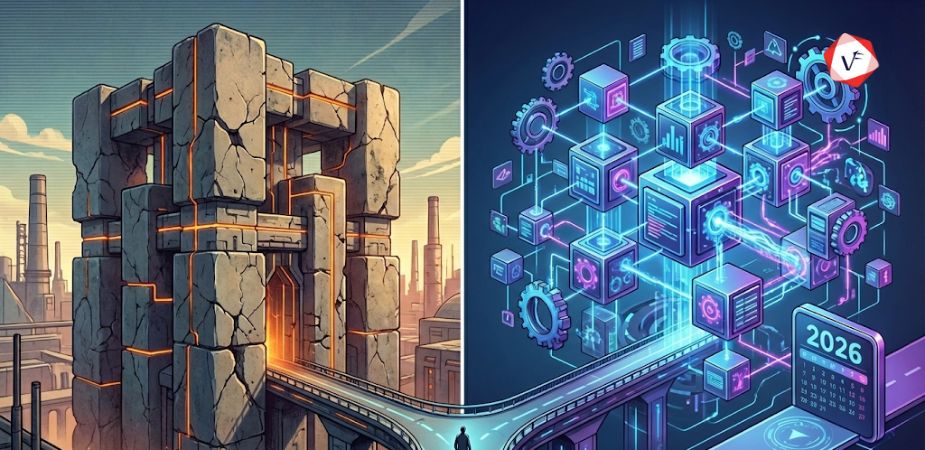
Software architecture decisions shape the future of every application. When choosing between microservices architecture and monolithic architecture, developers and organizations face a critical decision that impacts scalability, maintenance, and team productivity. The microservices vs monolith debate continues to be relevant as businesses seek optimal solutions for their unique requirements.
Understanding the fundamental differences between these architectural patterns helps teams make informed decisions that align with their technical capabilities, business goals, and long-term vision for growth and innovation.
Understanding Monolithic Architecture Fundamentals
Monolithic architecture represents the traditional approach to building software applications, where all components exist within a single deployable unit. In monolithic systems, the user interface, business logic, and data access layers are tightly coupled and deployed together as one cohesive application. This architectural pattern has powered countless successful applications and continues to serve many organizations effectively.
Advantages of Monolithic Architecture
The monolithic approach offers several advantages that make it attractive for many projects:
- Simplified development: Teams work with familiar tools and processes, making it easier to understand the entire application structure
- Straightforward debugging: All code exists in one place, allowing developers to trace issues across the entire system without navigating multiple services
- Simplified testing: The entire application can be tested as a single unit with less complex test infrastructure
- Performance benefits: Inter-component communication happens through method calls rather than network requests, eliminating latency concerns
- Simple transactions: Database operations remain consistent using a single database instance with ACID guarantees
Challenges of Monolithic Architecture
However, monolithic architecture presents challenges as applications grow in complexity and size:
- Scaling limitations: The entire application must be scaled as one unit, even if only specific components need more resources
- Technology constraints: All components must use the same programming language and frameworks
- Maintenance complexity: Large codebases become difficult to understand and maintain, especially with multiple teams
- Deployment risks: Any change requires redeploying the entire application, increasing risk of system-wide failures
- Limited flexibility: Difficult to adopt new technologies or refactor specific components without affecting the whole system
Microservices Architecture Deep Dive
Microservices architecture breaks down applications into smaller, independent services that communicate through well-defined APIs. Each microservice handles specific business functionality and can be developed, deployed, and scaled independently. This architectural pattern has gained significant popularity among organizations seeking greater flexibility and scalability in their software systems.
Benefits of Microservices Architecture
The microservices approach offers compelling benefits for complex applications and large development teams:
- Independent deployment: Teams can release updates to individual services without affecting the entire system
- Technology diversity: Each microservice can use different programming languages, databases, and frameworks based on specific requirements
- Fault isolation: Failures in one service don’t necessarily bring down the entire application
- Granular scalability: Individual microservices can be scaled based on demand rather than scaling the entire application
- Team autonomy: Different teams can own and maintain specific microservices without extensive coordination
- Faster development cycles: Independence leads to improved productivity for larger organizations
Challenges of Microservices Architecture
Microservices architecture also introduces significant complexity and challenges:
- Network overhead: Service-to-service communication adds latency and potential failure points
- Complex monitoring: Requires sophisticated logging, tracing, and debugging tools across multiple services
- Data consistency: Transactions spanning multiple microservices often require eventual consistency patterns
- Operational complexity: Needs container orchestration, service discovery, and API gateway management
- Distributed systems expertise: Teams must understand concepts like distributed transactions, network failures, and service meshes
- Testing complexity: Integration testing becomes more challenging across multiple independent services
Performance Considerations & Trade-Offs
Monolithic Performance Characteristics
Monolithic applications typically demonstrate superior performance for operations that require tight integration between components:
- Direct method calls: Faster than network requests between microservices
- Efficient database operations: All data access happens through a single connection pool
- Shared caching: Can implement caching mechanisms more easily within the application
- ACID transactions: Full support for database transactions and relational features
- Lower latency: No network overhead for inter-component communication
Microservices Performance Characteristics
Microservices introduce network overhead that can impact overall system performance:
- Network latency: Each service-to-service communication involves serialization and network costs
- Distributed caching: Requires more complex solutions like Redis or Memcached clusters
- Eventual consistency: May use different database technologies optimized for specific use cases
- Targeted optimization: Each microservice can be optimized for its particular workload independently
- Granular load balancing: More control over traffic distribution but requires additional infrastructure
However, microservices can achieve better performance in specific scenarios through targeted optimization of individual services. Teams can optimize each microservice for its particular workload without compromising other parts of the system.
Development Team Structure & Organizational Impact
Monolithic Architecture and Team Dynamics
Monolithic architecture works well for smaller teams where everyone can understand the entire codebase:
- Low communication overhead: All developers work on the same application with shared context
- Natural knowledge sharing: Team members work with the same technologies and codebase
- Centralized decision-making: Architecture and technical decisions can be made quickly
- Deep expertise: Teams develop deep knowledge in specific technology stacks
- Simpler onboarding: New developers learn one unified codebase and technology stack
Microservices and Conway’s Law
Microservices architecture aligns well with larger organizations following Conway’s Law, where system architecture mirrors organizational communication patterns:
- Team autonomy: Different teams can own specific microservices, reducing dependencies
- Parallel development: Multiple teams can work simultaneously without blocking each other
- DevOps ownership: Teams take full responsibility from development through production
- Broader skillsets: Requires expertise in distributed systems, containerization, and orchestration
- Critical documentation: API versioning and service contracts become essential
- Cross-team coordination: Service boundaries must be well-defined and maintained
However, microservices require more mature development practices and organizational capabilities. Teams need expertise in distributed systems, containerization, orchestration, and monitoring. Communication between teams becomes critical since service boundaries must be well-defined and maintained.
Operational Complexity & Maintenance Requirements
Monolithic Operations
Monolithic applications require simpler deployment and operational procedures:
- Single deployment artifact: Only one application needs to be deployed and managed
- Consolidated monitoring: Straightforward logging and metrics collection
- Simpler security: Fewer network boundaries to secure
- Basic disaster recovery: Less complex backup and recovery procedures
- Easier updates: Patches and dependency management affect only one application
Microservices Operational Overhead
Microservices introduce significant operational overhead that organizations must be prepared to handle:
- Container orchestration: Platforms like Kubernetes become necessary for managing multiple services
- Infrastructure components: Service discovery, load balancing, and API gateways require maintenance
- Distributed tracing: Essential for troubleshooting issues across multiple services
- Log aggregation: Centralized logging systems needed to correlate events across services
- Complex security: Must secure communication between numerous services with authentication and authorization
- Version management: Coordinated updates and careful attention to backward compatibility
- Advanced monitoring: Requires sophisticated tools to track service health, dependencies, and performance
Maintenance activities like updates, patches, and dependency management are simpler in monolithic systems. Microservices require coordinated updates across multiple services and careful attention to backward compatibility.
When Monolithic Architecture Makes Sense
Monolithic architecture remains the optimal choice for many scenarios in 2025:
Ideal Use Cases for Monoliths
- Small to medium applications: Well-defined requirements benefit from simplicity and straightforward development
- Startups and small teams: Limited resources and need for rapid development cycles
- Tightly coupled business logic: When most operations require data from multiple domains
- Real-time systems: Applications requiring low latency perform better without network overhead
- Limited DevOps maturity: Organizations lacking sophisticated monitoring and deployment capabilities
- Budget constraints: Lower infrastructure costs with simpler hosting requirements
- Single domain applications: Clear business boundaries within one cohesive system
- Teams under 10 developers: Easier coordination and knowledge sharing with smaller groups
Organizations with limited DevOps maturity should consider a monolithic architecture. The operational complexity of microservices requires sophisticated monitoring, deployment, and orchestration capabilities that may not justify the investment for smaller applications. Teams lacking expertise in distributed systems may struggle with the complexity of microservices.
Budget constraints can make monolithic architecture more attractive. The infrastructure costs for running multiple microservices, including container orchestration, service mesh, and monitoring tools, can be high. Monolithic applications typically require fewer infrastructure resources and simpler hosting arrangements.
The Case for Microservices in 2025
Microservices architecture becomes advantageous for organizations facing specific scalability and organizational challenges:
When Microservices Excel
- Large-scale applications: Serving millions of users with the ability to scale components independently based on demand
- Multiple development teams: Organizations with 50+ developers benefit from team autonomy and reduced coordination overhead
- Multiple business domains: Different domains with distinct requirements can be optimized separately
- Technology diversity needs: Different services require different programming languages, databases, or frameworks
- High availability requirements: Ability to isolate failures and maintain partial system functionality
- E-commerce platforms: Need for independent scaling of catalog, checkout, inventory, and payment services
- Social media applications: Require separate scaling for feeds, messaging, media processing, and notifications
- Content delivery systems: Benefits from a distributed architecture for global reach
Organizations with multiple development teams find that microservices enable better team autonomy and reduced coordination overhead. When different business domains have distinct requirements, microservices allow teams to optimize their services for specific needs. This independence often results in faster feature delivery and improved innovation.
Technology diversity requirements make microservices attractive. Organizations wanting to use different programming languages, databases, or frameworks for different business functions can leverage microservices to match technology choices with specific requirements. Machine learning services, real-time analytics, and legacy system integrations often benefit from technology-specific optimizations.
High availability requirements favor microservices when implemented correctly. The ability to isolate failures and maintain partial system functionality can provide better user experiences during outages. Financial services, healthcare systems, and critical infrastructure applications often require this level of resilience.
Making the Right Choice: Decision Framework
Use this framework to evaluate which architecture best fits your specific situation:
Team Size Considerations
- Under 10 developers: Monolithic architecture is typically more manageable
- 10-50 developers: Either approach can work depending on application complexity
- 50+ developers: Microservices may provide better team independence and parallel development
Application Complexity Assessment
- Single business domain: Monolithic architecture works well
- Multiple distinct domains: Consider microservices if clear service boundaries exist
- Tightly coupled operations: Monolith reduces complexity
- Independent scalability needs: Microservices provide targeted scaling
Performance Requirements
- Extremely low latency: Monolithic architecture typically performs better
- Variable component load: Microservices enable independent scaling
- High throughput needs: Both can work with proper optimization
Organizational Maturity
- Mature DevOps practices: Ready for microservices complexity
- Distributed systems expertise: Can successfully implement and maintain microservices
- Limited operational capabilities: Start with monolithic while building maturity
- Sophisticated monitoring systems: Essential for microservices success
Organizations with mature DevOps practices, monitoring systems, and distributed systems expertise can successfully implement microservices. Teams lacking these capabilities should focus on building monolithic applications while developing operational maturity.
Conclusion
The choice between microservices and monolithic architecture in 2025 depends on organizational context, technical requirements, and team capabilities. Monolithic architecture offers simplicity and performance benefits for smaller applications and teams, while microservices provide scalability and flexibility for complex systems with mature operational practices.
Success with either approach requires understanding the trade-offs and aligning architectural decisions with business objectives. Organizations should evaluate their specific needs, team structure, and technical capabilities before making this critical decision.
Need expert guidance on choosing the right architecture for your project? Vofox’s software consulting services provide expert guidance in choosing and implementing the right architectural approach for your specific requirements. Contact our experts today to learn how we can help you build scalable, maintainable applications tailored to your needs.