Here’s something most developers don’t think about: every time your code executes, somewhere a server draws power from the grid. Maybe it’s coal. Maybe it’s natural gas. Occasionally, if you’re lucky, it’s wind or solar.
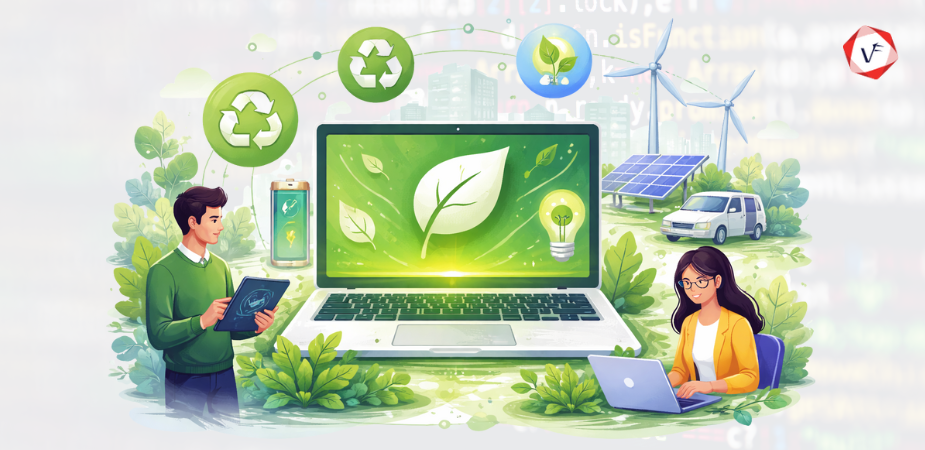
Green software is the practice of building applications that minimize environmental impact through efficient code, smart resource management, and reduced carbon emissions. It’s not about making your app literally green. It’s about acknowledging that software, despite being invisible and weightless, has a very real carbon footprint.
I’ve watched this shift happen over the past few years. What started as a niche concern among sustainability-minded engineers has become something larger companies actually care about. And for good reason. The numbers are harder to ignore now.
The Real Environmental Cost of Software
Most people think of software as clean technology. No smokestacks. No oil spills. Just elegant lines of code floating in the cloud.
Except the cloud isn’t actually a cloud. It’s massive data centers packed with servers that run 24/7, cooled by industrial HVAC systems, all drawing electricity from whatever power source happens to be available. Those data centers consume somewhere between 1% and 2% of global electricity. That’s roughly equivalent to the entire aviation industry’s carbon footprint.
The environmental impact of software shows up in three main places:
- Operational emissions: The electricity consumed while your application runs on servers, networks, and user devices
- Embodied emissions: The carbon cost of manufacturing the hardware your software runs on, from smartphones to server racks
- End-user energy consumption: How much battery life your app drains and the processing power it demands from devices
What makes this interesting is how much control developers actually have. Inefficient code doesn’t just slow things down. It forces processors to work harder and longer. Background processes that sync unnecessarily. Database queries that pull entire tables when you need three rows. Unoptimized images that get transmitted at full resolution when a compressed version would work fine.
All of that translates to higher energy consumption. And higher energy consumption, in most parts of the world, means more carbon emissions.
What Makes Software “Green”?
Green software development rests on a few core ideas. They’re not complicated, but they do require a shift in how you think about building applications.
Energy Efficiency First
This is the foundation. Write code that accomplishes what it needs to accomplish using the minimum computational resources necessary. That means cleaning up redundant operations, streamlining algorithms, and making sure your application only wakes up when it actually has work to do.
It sounds obvious. But you’d be surprised how much code gets written without anyone asking, “Does this really need to run this way?”
Carbon Awareness
Here’s where it gets more sophisticated. Not all electricity is created equal. The carbon intensity of power varies dramatically based on time and location. On a sunny afternoon in California, the grid might be running on 60% renewable energy. At 3 AM in a coal-dependent region, that number drops to maybe 15%.
Carbon-aware software adjusts its behavior based on these conditions. Energy-intensive tasks like video processing, large data transfers, or model training can be scheduled for times when renewable energy is abundant. Your application doesn’t work any differently from the user’s perspective, but its carbon footprint drops significantly.
Hardware Efficiency
Green software extends the useful life of existing hardware. Applications should run smoothly on older devices rather than forcing users into upgrade cycles they don’t actually need.
This principle addresses both environmental and accessibility concerns. Electronic waste is a growing problem. And not everyone can afford to replace their phone every two years just because apps keep getting more resource-hungry.
How to Actually Build Greener Applications
Principles are nice. Implementation is what matters. Here’s what sustainable software development looks like in practice.
Code Optimization
Start with the basics. Clean, well-structured code performs better and requires less energy to execute. That means:
- Eliminating unnecessary loops and recursive functions that spiral out of control
- Managing memory efficiently to avoid constant allocation and garbage collection
- Using appropriate data structures that match your actual use case
- Avoiding premature optimization, but not ignoring obvious inefficiencies
I’ve seen applications cut their server load in half just by fixing a few poorly designed database queries. Sometimes the biggest wins come from the most mundane improvements.
Smart Data Management
Every byte you transfer across the network consumes energy. Not just on the server, but across all the infrastructure between your data center and the end user’s device.
Sustainable data management means:
- Compressing files before transmission
- Caching frequently accessed information locally instead of fetching it repeatedly
- Only syncing data that’s actually changed rather than doing full updates
- Using content delivery networks to reduce transmission distances
Cloud storage is convenient. But judiciously chosen, not default. Ask yourself whether that data really needs to live in three different places.
Language and Framework Choices
Some programming languages are inherently more energy-efficient than others. C and Rust typically execute with less overhead than Python or Ruby. That doesn’t mean you should rewrite everything in C. Developer productivity matters. Project requirements matter.
But it’s worth knowing these efficiency differences exist. For computationally intensive operations, choosing a more efficient language can make a measurable difference in energy consumption.
Architecture Decisions
How you structure your application has profound effects on its environmental impact. Serverless computing, when implemented thoughtfully, eliminates idle time. Your code only runs when triggered by specific events, consuming resources precisely when needed.
Microservices architectures allow different components to scale independently. Your authentication service might need to run constantly, but that batch processing job? It can spin up, do its work, and shut down.
Edge computing moves processing closer to end users, reducing data transfer and latency. It’s not always the right choice, but when it fits your use case, it can significantly reduce energy consumption.
Measuring Your Software’s Carbon Footprint
You can’t improve what you don’t measure. That’s the management consultant version. The developer version is: vague intentions don’t change anything without concrete data.
Software Carbon Intensity (SCI) has emerged as the standard metric for measuring emissions. It calculates carbon emissions per unit of work your application performs, accounting for operational emissions, embodied hardware emissions, and the carbon intensity of consumed electricity.
Several open-source tools now exist to help track this:
- Cloud Carbon Footprint monitors emissions across major cloud providers
- Green Metrics Tool measures energy consumption of containerized applications
- CodeCarbon tracks emissions during machine learning model training
Real-time monitoring reveals which features consume the most resources. Maybe it’s that analytics dashboard that refreshes every 30 seconds. Maybe it’s an image processing pipeline that never got optimized. You won’t know until you measure.
The challenge is that software emissions involve complex calculations across distributed infrastructure. Unlike a factory where you can measure smokestack output directly, software’s footprint is spread across data centers, networks, and millions of end-user devices. Standardized methodologies are still evolving, which makes year-over-year comparisons tricky.
Why Companies Are Paying Attention
Environmental responsibility is important. But let’s be honest about what moves large organizations: money and risk.
Green software reduces operational costs. Applications that use fewer server resources mean smaller cloud computing bills. More efficient code means less infrastructure to maintain. I’ve watched companies cut their AWS spending by 30% or more just by optimizing resource usage. The sustainability benefit was almost a side effect.
Consumer preferences are shifting, too. Not universally, but enough to matter. Younger customers particularly consider sustainability when choosing products and services. Companies that can credibly demonstrate environmental commitment gain competitive advantages in certain markets.
Regulatory pressure continues mounting. The EU’s Corporate Sustainability Reporting Directive now requires companies to disclose environmental impact, including digital operations. Similar legislation is appearing in other regions. Organizations that adopt green software practices proactively avoid scrambling to meet compliance requirements later.
There’s also the talent angle. Engineers, especially younger ones entering the field, increasingly want to work for companies that take sustainability seriously. It’s not the only factor in job decisions, but it’s no longer negligible either.
The Obstacles Nobody Talks About
Green software development sounds straightforward in theory. In practice, several challenges complicate adoption.
Legacy systems pose the biggest headache. Older applications often lack the architecture and documentation needed for effective optimization. Retrofitting these systems requires substantial investment and specialized expertise. Many organizations look at the cost and complexity, then decide to wait until the next major rebuild. Which might be years away.
Developer awareness remains surprisingly limited. Most software engineers receive zero training in sustainable development practices during their education. It’s not part of most computer science curricula. Companies have to invest in training programs and cultural shifts to embed environmental considerations into development processes.
Accurate measurement presents technical difficulties. The calculation models keep evolving. Different tools produce different results. Comparing your application’s carbon footprint to a competitor’s isn’t as straightforward as comparing website load times.
Performance trade-offs sometimes emerge. While optimization generally improves both speed and efficiency, certain green software strategies require compromises. Scheduling tasks during periods of renewable energy availability might delay execution. Geographic load balancing might increase latency for some users. These aren’t dealbreakers, but they require thoughtful implementation.
Green Software in the Cloud Era
Cloud computing presents a paradox. On one hand, massive data centers consume enormous amounts of energy. On the other hand, they enable optimization strategies impossible with a distributed on-premises infrastructure.
The major cloud providers (AWS, Azure, Google Cloud) have all committed to renewable energy targets. Amazon aims for 100% renewable energy by 2025. Microsoft wants to be carbon negative by 2030. Google claims to match 100% of its electricity consumption with renewable energy purchases.
How much of this is genuine progress versus creative accounting depends on who you ask. But the direction is clear.
Rightsizing Resources
Many applications over-provision computing resources dramatically. You pay for capacity that sits idle 80% of the time while consuming energy continuously. Auto-scaling features allow applications to expand during peak usage and contract during quiet periods.
This dynamic allocation matches resources to actual demand. Your application performs well when traffic spikes, but you’re not running (and paying for) dozens of servers overnight when nobody’s using it.
Container Efficiency
Container technologies like Docker and orchestration platforms like Kubernetes enhance resource utilization. They pack workloads densely onto physical servers, maximizing hardware usage and minimizing idle capacity.
Instead of running ten applications on ten separate virtual machines, you might run them all on three physical servers. Each machine operates at higher utilization, which is significantly more energy-efficient than running multiple underutilized machines.
Geographic Distribution
Different regions have different carbon intensities of electricity. Iceland runs almost entirely on geothermal and hydroelectric power. Parts of China rely heavily on coal. Cloud providers operate data centers globally.
Green software can route workloads to locations where renewable energy is abundant. For tasks without strict latency requirements (batch processing, video encoding, data analysis), geographic load balancing reduces overall carbon emissions while maintaining performance.
Serverless Architecture
Serverless computing eliminates idle time entirely. Code executes only when triggered by specific events. No requests? No servers running. No energy consumed.
This pay-per-execution model aligns perfectly with green software principles. You’re not maintaining always-on infrastructure waiting for work. Resources appear precisely when needed, then disappear.
Serverless isn’t appropriate for every use case. But where it fits, the efficiency gains are substantial.
Where This Is All Heading
The green software movement is gaining momentum. Industry consortia like the Green Software Foundation bring together organizations to develop standards, share best practices, and create open-source resources. These collaborative efforts accelerate adoption by providing frameworks that individual companies can implement.
Artificial intelligence offers promising possibilities for advancing sustainable software. Machine learning can optimize resource allocation, predict energy consumption patterns, and automate efficiency improvements. But AI itself presents environmental challenges. Training large language models consumes enormous amounts of energy. GPT-3’s training reportedly generated as much carbon as driving a car 700,000 miles.
Researchers are developing more efficient algorithms and training methods. Techniques like transfer learning, model compression, and federated learning reduce computational requirements. It’s an active area of research with real stakes.
I expect green software practices to become table stakes over the next five years. Not because every developer suddenly becomes an environmental activist, but because the business case strengthens. Lower costs. Regulatory compliance. Customer expectations. These forces push in the same direction.
The developers who learn these practices now will have advantages later. The companies that build sustainability into their development processes from the beginning won’t have to retrofit everything when regulations tighten or customers demand transparency.
Final Thoughts
Green software isn’t about sacrifice or accepting inferior products. It’s about building better applications that happen to consume less energy and produce fewer carbon emissions.
Most optimization work improves performance anyway. Faster code uses less energy. Efficient data management reduces both bandwidth costs and environmental impact. Smart architecture decisions benefit users and the planet simultaneously.
There’s no perfect answer here. Trade-offs exist. Measurement remains imperfect. But that’s not a reason to wait. Starting with basic optimization, measuring what you can, and making incremental improvements produces real results.
If you’re looking to build sustainable applications that balance performance with environmental responsibility, consider working with teams that understand both the technical and sustainability aspects. The goal is software that works well while minimizing its footprint.
The industry is moving in this direction, whether individual developers and companies lead or follow. Might as well get ahead of it.