Good things, to be clear. The system started noticing patterns in vendor pricing, flagging unusual charges, and even negotiating payment terms on its own. Nobody told it to do any of that. It just understood the goal was optimizing cash flow and figured out how to get there.
That’s the shift happening right now with agentic AI in business transformation. We’re not talking about smarter automation anymore. We’re talking about systems that think, adapt, and make decisions like employees do, except they never sleep and they learn faster than any human could.
If that sounds unsettling or exciting or both, you’re paying attention.
What We’ll Cover
What makes agentic AI different from automation
Let’s start with what it’s not.
Traditional automation is like a very reliable robot. You program exactly what it should do, step by step, and it does that thing perfectly every single time. A robotic arm welding car frames. Software that processes expense reports according to fixed rules. Chatbots that match your question to a database of scripted responses.
These systems are valuable. They’re fast, consistent, and they free humans from repetitive work. But they’re also rigid. Show them something they weren’t programmed for and they either fail or escalate to a human.
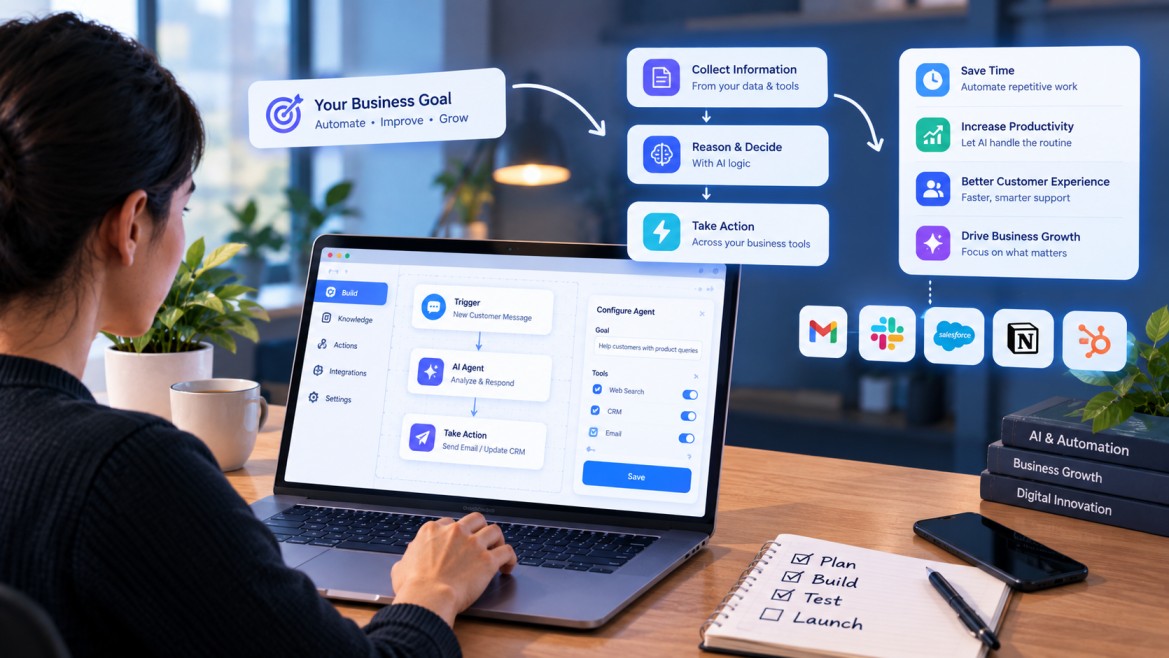
Agentic AI works differently. You give it a goal, not instructions.
Tell an agentic AI system to “resolve customer complaints efficiently” and it figures out how. It reads the complaint, understands what the customer actually wants, checks order history, determines if a refund or replacement makes more sense, processes whichever option it chooses, and follows up to confirm satisfaction. When it runs into something unusual, it reasons through potential solutions rather than immediately giving up.
The difference is autonomy backed by understanding. These systems comprehend context the way humans do. They can read between the lines, make judgment calls, and adapt their approach based on what’s working.
This capability comes from several technologies working together. Large language models handle natural language understanding. Retrieval systems give agents access to company knowledge across databases and documents. Planning algorithms let them break complex goals into steps. Memory systems help them learn from experience and maintain context through long interactions.
Put all that together and you get something that feels less like software and more like a very competent employee who happens to process information at machine speed.
Where it’s transforming business functions right now
Agentic AI isn’t theoretical anymore. It’s running actual business operations across industries.
Customer service that actually solves problems
I’ve seen agentic AI customer service systems handle inquiries end-to-end in ways traditional chatbots never could. They don’t just answer questions. They troubleshoot technical issues, process returns and refunds, reschedule appointments, and proactively reach out when they detect problems brewing.
Companies implementing these systems report resolution rates above 80% without human intervention. Customer satisfaction scores often match or beat human-staffed operations because the agents are consistent, patient, and available instantly.
The difference shows up in how they handle complexity. A customer might say “my order never arrived and I need it by Thursday for my daughter’s birthday.” A traditional chatbot would struggle with that. An agentic AI system understands the urgency, checks shipping status, realizes the original delivery won’t make it, offers expedited replacement or refund, and makes a decision based on inventory and shipping times. All in seconds.
Sales that adapts to each prospect
Sales teams are using agentic AI to qualify leads, personalize outreach, and manage follow-up sequences at scale. These systems analyze how prospects behave, determine optimal timing and messaging for each contact, and adjust their approach based on responses.
If email isn’t working with a particular prospect, the agent might shift to LinkedIn messages or phone calls. If technical details resonate, it provides more. If the prospect cares about ROI, it focuses there. The system learns what works for different types of buyers and adapts accordingly.
Sales teams report this lets them focus on high-value conversations while the agent handles relationship nurturing for hundreds or thousands of leads simultaneously. That’s not possible with human effort alone.
Operations that self-correct
In supply chain and operations, agentic AI systems optimize inventory, route shipments, and respond to disruptions autonomously.
When a supplier shipment gets delayed, an agentic AI system doesn’t just alert someone. It identifies alternative suppliers, requests quotes, evaluates options against cost and timeline constraints, places orders, and updates production schedules. The problem gets solved without human intervention unless the situation is truly unusual.
This level of autonomous problem-solving keeps operations running smoothly. Humans set strategy and handle exceptions. The agent manages the daily execution and routine disruptions.
Finance that understands intent
Financial operations are being transformed by agentic AI systems that handle accounts payable and receivable, reconcile transactions, identify anomalies, and ensure compliance.
These systems understand accounting principles well enough to make judgment calls about transaction classification. They don’t just follow rules mechanically. They understand the intent behind financial policies and can explain their reasoning when questioned.
That’s crucial because finance involves constant edge cases where human judgment is normally required. Agentic AI doesn’t eliminate that need, but it dramatically reduces how often humans must intervene.
The technical foundation you actually need
Deploying sophisticated AI models is the easy part. The hard part is building the foundation those models need to be useful.
Your data infrastructure has to be ready
Agentic AI systems need real-time access to information across your entire organization. If your data lives in disconnected silos, if systems can’t talk to each other, if information is outdated or inconsistent, your agents will be severely limited in what they can accomplish.
I’ve seen companies excited about agentic AI in business transformation hit a wall when they realize their data infrastructure isn’t ready. They end up needing parallel investments in data integration, API development, and system modernization before the agents can really work.
That’s not a reason to delay. It’s a reason to start planning now. Data infrastructure improvements benefit everything else you’re doing anyway.
Security and governance can’t be afterthoughts
When an agentic AI system can access customer data, place orders, or modify records, you need robust controls ensuring it acts within appropriate boundaries.
This means implementing proper authentication, comprehensive audit logs, approval workflows for high-stakes decisions, and mechanisms to detect when an agent is behaving unexpectedly. It means defining clear boundaries for what agents can and cannot do.
Organizations successful with agentic AI in business transformation invest heavily in these governance layers before widespread deployment. The ones that don’t end up dealing with incidents that could have been prevented.
Humans need good interfaces to work with agents
Employees need ways to guide agentic AI systems, review their decisions, and intervene when necessary. This isn’t optional. Even the most capable agent will encounter situations requiring human judgment.
The best implementations create collaborative partnerships. Humans set strategy and handle edge cases. Agentic AI executes routine operations and flags situations requiring human attention. The interface design that makes this collaboration intuitive significantly impacts whether people actually use the system effectively.
I’ve seen powerful agentic AI systems underutilized because the interface was clunky and people didn’t understand how to work with them. Good UI matters more than you’d think.
How to measure if it’s working
Quantifying returns from agentic AI requires looking beyond simple cost displacement.
Labor savings are just the start
Yes, you’ll likely reduce labor costs in certain areas. But the more substantial value often comes from capabilities that weren’t previously possible or economically viable.
An agentic AI system might enable personalized customer engagement at a scale no human team could achieve, opening new market segments. It might compress decision-making cycles from days to minutes, letting you capitalize on opportunities that would otherwise slip away. It might provide 24/7 coverage across time zones without the cost of around-the-clock staffing.
These capability gains often deliver more value than the direct cost savings, but they’re harder to quantify upfront.
Track multiple dimensions of impact
Organizations measuring agentic AI business transformation should look at operational metrics like throughput, error rates, and cycle time. These typically show impressive improvements.
Customer experience metrics including satisfaction scores, retention rates, and lifetime value often increase as agentic AI enables more responsive and personalized interactions.
Employee satisfaction frequently rises as people shift from repetitive tasks to more engaging work. That’s not a soft metric. Higher satisfaction translates to better retention and productivity.
Revenue metrics may show growth from new offerings that agentic AI makes economically viable. Products or services that were too labor-intensive to scale profitably might become core business lines.
Expect an investment period
Some agentic AI applications deliver immediate benefits. Others require time as the systems learn organizational context and build knowledge bases.
Most organizations report positive ROI within 12 to 18 months, with returns accelerating as agents become more capable and teams discover additional use cases. The early months involve data preparation, system integration, and training. Then benefits start compounding.
Going in with realistic timeline expectations helps maintain organizational support through the initial investment period.
Challenges nobody warns you about
Implementing agentic AI in business transformation comes with obstacles that aren’t always obvious upfront.
Technical challenges go deeper than you expect
System integration is often more complex than anticipated. Agentic AI needs to connect with legacy systems that weren’t designed for API access. Data quality issues that seemed minor suddenly matter enormously because agents make decisions based on that data.
Organizations with poor data hygiene find their agents making decisions based on incorrect or outdated information. The agent works exactly as designed, but garbage in means garbage out.
Model reliability presents ongoing challenges too. Agentic AI can behave unpredictably in edge cases. It might develop unexpected biases, misinterpret ambiguous situations, or generate inappropriate responses. You need rigorous testing before deployment, comprehensive monitoring afterward, and rapid incident response capabilities.
Accept that you’re deploying systems that will occasionally make mistakes. The question is whether you have processes to catch and correct those mistakes quickly.
Change management makes or breaks adoption
Employees often resist agentic AI systems they perceive as threats to job security. Middle managers might see them as undermining their authority. Getting organizational buy-in requires transparent communication about how agentic AI augments rather than replaces human workers.
This isn’t just about messaging. You need retraining programs that help employees develop new skills for working alongside agents. You need demonstrable commitment from leadership that this technology enhances jobs rather than eliminating them.
I’ve seen technically successful agentic AI implementations fail because the organization didn’t handle this change management piece. The technology worked fine. People just wouldn’t use it.
Regulatory and ethical questions remain unsettled
In regulated industries like healthcare and finance, ensuring agentic AI systems comply with relevant laws is complex. Questions about accountability when autonomous systems cause harm remain legally unsettled in many jurisdictions.
Who’s responsible when an agent makes a bad decision that costs money or harms someone? The organization? The developers? The AI itself? Different jurisdictions are answering these questions differently, and the landscape keeps shifting.
Organizations implementing agentic AI need legal and compliance teams involved from the start. This isn’t something you can retrofit after deployment.
Ready to explore agentic AI for your business?
At Vofox Solutions Inc, we provide comprehensive AI/ML development services that help businesses implement agentic AI strategically and responsibly. From initial strategy through deployment and optimization, our team guides you through every phase of business transformation.
Let’s discuss how agentic AI can transform your operations. Contact us to start your AI journey with expert support.
Where this technology is headed
The trajectory of agentic AI in business transformation points toward capabilities that sound like science fiction but are closer than you might think.
Multi-domain agents that work across functions
Current agentic AI systems mostly operate within single domains. A customer service agent handles customer service. A finance agent handles finance. But multi-domain agents that work across business functions are emerging.
Imagine an agent that handles a customer complaint by checking order status in the logistics system, coordinating with the warehouse for expedited shipping, processing a partial refund through finance, updating the CRM with the interaction details, and maintaining a coherent conversation with the customer through all of it.
That level of cross-functional autonomy will dramatically reduce handoffs and delays that currently slow organizations down.
Collaborative agent teams
Rather than individual agents working in isolation, organizations will deploy networks of specialized agents that coordinate to accomplish complex objectives.
A business development agent might work with research agents to analyze markets, content generation agents to create proposals, and negotiation agents to finalize contracts. Each agent brings specialized expertise, but they collaborate toward shared goals.
This distributed intelligence could tackle challenges that single agents cannot. Complex problems get decomposed and solved in parallel by agents with complementary skills.
Continuous learning and institutional knowledge
Current agentic AI systems learn primarily during training, with limited adaptation during deployment. Future systems will continuously improve through experience, developing institutional knowledge and expertise over time.
Organizations will cultivate agent capabilities the way they currently develop employee skills. Your agents will become better at understanding your specific business, your customers, your industry over months and years of operation.
That creates competitive advantages through proprietary agent knowledge that competitors can’t simply purchase. Your agents know things about your business that no external system could.
Common questions answered
What is agentic AI and how is it different from regular AI?
Agentic AI refers to systems that can reason, make decisions, and take actions with minimal human oversight. Unlike traditional automation that follows rigid scripts, agentic AI understands context, learns from experience, and adapts its behavior to achieve desired outcomes. You give it goals rather than step-by-step instructions. The system figures out how to accomplish those goals, handling unexpected situations and making judgment calls along the way.
How is agentic AI transforming business operations?
Agentic AI transforms businesses by handling complex tasks autonomously across customer service, sales, operations, and finance. It doesn’t just automate repetitive tasks but makes judgment calls, adapts to new situations, and solves problems independently. Companies implementing these systems report resolution rates exceeding 80% without human intervention in customer service, while seeing improvements in sales conversion, operational efficiency, and financial accuracy.
What do businesses need to implement agentic AI successfully?
Successful implementation requires integrated data infrastructure so agents can access information across the organization, robust security and governance frameworks to ensure agents act within appropriate boundaries, clear human-AI interfaces for collaboration, and strong change management to get organizational buy-in. You also need quality data, system integration capabilities, and commitment to ongoing monitoring and improvement.
What are the biggest challenges with agentic AI implementation?
Major challenges include integrating with legacy systems that lack modern APIs, addressing data quality issues that become critical when agents make autonomous decisions, handling unpredictable model behavior in edge cases, overcoming employee resistance to perceived job threats, and ensuring compliance with regulations in industries like healthcare and finance. Organizations need comprehensive testing, monitoring, governance, and change management programs to address these challenges effectively.
How long does it take to see ROI from agentic AI?
Most organizations report positive ROI within 12 to 18 months, with returns accelerating as agents become more capable and teams discover additional use cases. Some applications deliver immediate benefits through task automation, while others require longer periods for data preparation, system integration, and organizational learning. The initial months involve investment in infrastructure and training, then benefits start compounding as the system matures.
Will agentic AI replace human workers?
Agentic AI augments human workers rather than replacing them wholesale. It handles routine tasks, repetitive operations, and problems that follow established patterns, freeing humans to focus on strategy, creativity, complex problem-solving, and situations requiring empathy or nuanced judgment. Most implementations result in role evolution rather than elimination, with employees shifting to higher-value work that leverages uniquely human capabilities.
Is agentic AI secure for handling sensitive business data?
Agentic AI can be secure when implemented with proper governance, authentication, audit logging, and access controls. Organizations need to establish clear boundaries for what agents can access and do, implement monitoring to detect unusual behavior, and ensure compliance with relevant regulations. Security is not automatic but must be designed into the system from the start with input from security and compliance teams.
How do you measure if agentic AI is working?
Measure across multiple dimensions: operational metrics like throughput, error rates, and cycle time; customer experience metrics including satisfaction and retention; employee satisfaction and productivity; and revenue impact from new capabilities. Look beyond simple cost savings to capability gains like 24/7 availability, personalized engagement at scale, or compressed decision cycles. Track both immediate benefits and longer-term value as agents become more capable.
Moving forward with agentic AI
Agentic AI in business transformation represents a genuine shift in what’s possible with technology. Not just faster automation, but systems that understand, adapt, and make decisions the way knowledgeable employees do.
The organizations seeing the most success are those that approach this strategically rather than tactically. They invest in the technical foundation first. They design governance and security frameworks before widespread deployment. They manage organizational change deliberately. And they start with focused applications where the value is clear and the risks are manageable.
There’s no perfect playbook because the technology is still evolving and every organization has unique needs. But the core principles remain consistent: build solid foundations, start focused, measure rigorously, and scale what works.
The competitive advantages from agentic AI are real and growing. Organizations that figure this out early while the technology is still maturing will be significantly ahead of those that wait until it’s mainstream. By then, the advantage will be in execution details rather than fundamental capabilities.
If you’re thinking about how agentic AI might fit into your business transformation, that’s exactly the right time to start exploring. Not with massive commitments, but with strategic pilots that let you learn what works in your specific context.
The technology is ready. The question is whether your organization is ready to evolve alongside it.