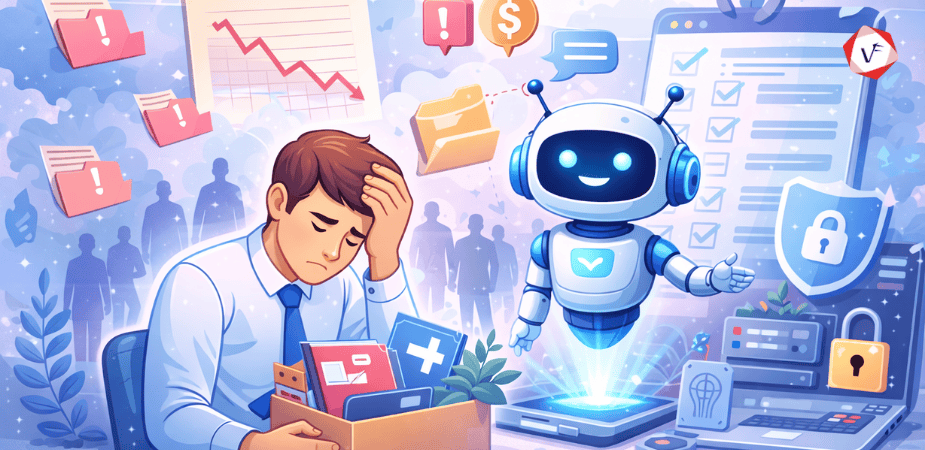
Someone I know lost their job last spring. They’d been at the company for six years, good performer, consistent reviews. The announcement called it a “strategic restructuring to accelerate AI investment.” Three hundred people out the door. The CEO sent a note that used the word “transformation” four times.My friend wasn’t working in a role that AI could easily replace. They were in operations, managing vendor relationships, navigating the kind of ambiguous interpersonal complexity that language models handle about as well as a hammer handles a screw. But they were still gone, in a round of cuts that got labeled an AI layoff in every headline that covered it.That gap between the label and the reality is what this piece is about. AI layoffs are real. But the reasons behind them are messier, more human, and more honest than most of the coverage suggests.
What the Layoff Numbers Actually Show
The scale of tech layoffs over the past two years has been striking. Tens of thousands of jobs cut across companies that, not long before, were competing aggressively to hire the same people. The narrative attached to many of these cuts has been AI — automation is here, roles are being replaced, the future of work is changing faster than anyone expected.
That narrative is partly true. And partly convenient.
If you look at when the big waves of layoffs actually happened — late 2022, through 2023, extending into 2024 — the timing tells a more complicated story. These cuts followed a period of extraordinary over-hiring during the pandemic boom. When interest rates rose sharply, the cost of capital increased, and companies that had been prioritizing growth at any cost suddenly needed to show profitability. Investors who’d been patient with burn rates stopped being patient almost overnight.
The companies that laid off the most people in 2023 also tended to be the ones that had grown fastest between 2020 and 2022. Meta famously called 2023 its “year of efficiency” after adding tens of thousands of employees in the years before. Alphabet, Amazon, Microsoft — same pattern. The cuts were real. The AI framing, in many cases, was added afterward.
That doesn’t mean automation wasn’t a factor at all. It was, in specific roles and specific functions. But “we over-hired during a boom and now interest rates are high” is a less narratively satisfying explanation than “the machines are coming for jobs.” One of those explanations makes investors excited. The other makes leadership look like it made mistakes.
When AI Is the Reason and When It’s the Excuse
There’s a real version of AI-driven job displacement happening right now, and it looks quite specific.
Customer service centers are the clearest example. AI chatbots that can handle a realistic range of queries — returns, account lookups, troubleshooting, policy questions — don’t need a break, don’t need training time, and don’t need benefits. Companies that used to employ hundreds of agents handling routine inbound volume are now employing significantly fewer. That’s not a cover story. That’s a direct substitution that’s been documented in quarterly filings and verified by the numbers.
Content moderation is another. Basic document processing. Certain data entry functions. Junior-level financial analysis. Some categories of software testing. These are areas where AI is doing work that humans used to do, and the headcount reductions are genuine.
But here’s where it gets complicated. When a large company cuts 10,000 people and calls it an AI restructuring, the actual AI-driven portion of that cut might be 1,500 roles in functions where automation is genuinely replacing tasks. The other 8,500 might be middle managers whose layers were judged redundant, sales teams in underperforming regions, product teams working on initiatives that got deprioritized, and yes, people like my friend in operations who were caught in a wave that had more to do with margin targets than machine learning.
The AI label gets applied to the whole thing because it tells a better story. “We’re streamlining in response to technological change” sounds like forward-thinking leadership. “We’re cutting headcount to hit EBITDA targets before the next board meeting” sounds like exactly what it is.
I’m not being cynical for its own sake here. This matters because the diagnosis shapes the response. If you believe AI is replacing everything, you make different decisions than if you understand which specific categories of work are actually at risk and which ones are caught in unrelated financial crosscurrents.
Which Jobs Are Actually at Risk and Which Ones Aren’t
There’s a pattern to what AI actually does well, and it gives you a reasonably clear picture of where genuine displacement is happening.
Work that involves high volume, predictable inputs, language processing, and well-defined outputs is where AI has made the most ground. Take a support inbox that receives 500 messages a day, 70 percent of which are asking the same 15 questions in different ways. AI handles that 70 percent comfortably now. The other 30 percent — the ambiguous, emotionally charged, complicated cases — still needs a person. What changes is how many people you need for that inbox overall.
The same logic applies to basic legal document review, certain categories of financial reporting, data extraction from structured documents, and a lot of early-stage research tasks. The AI doesn’t replace the lawyer or the analyst entirely. It handles the high-volume, low-judgment portion of their work, which then raises the question of how many of them you need.
What’s held up better than a lot of people predicted:
- Roles requiring genuine physical presence and dexterity in unpredictable environments
- Skilled trades where judgment is built on years of sensory experience
- Sales and relationship management at senior levels where trust accumulation matters
- Cross-functional leadership where the work is navigating human politics as much as solving technical problems
- Creative work that requires genuine cultural intuition rather than pattern recombination
The honest version of “which jobs are at risk” isn’t a list of job titles. It’s a question about the specific tasks inside a job. If most of what you do involves processing and summarizing information in predictable ways, that’s higher risk than a role where most of the work involves judgment calls in ambiguous situations with incomplete information. Most real jobs involve both. Which side of that divide your specific work falls on matters more than your job title.
The Quiet Rehiring Story Nobody’s Writing About
Here’s something that got less coverage than the layoff announcements: a substantial portion of the people laid off in the 2023-2024 waves found new jobs within months. The overall tech unemployment rate didn’t spike to the levels you’d expect given the scale of cuts. People moved. Some went to different companies. Some went to smaller firms and startups. Some went to non-tech industries that were actively hiring people with technical skills.
That’s not a comfortable story for either side of the AI debate. The “AI is destroying jobs” narrative needs sustained high unemployment to make its case. The “AI creates more jobs than it destroys” narrative needs clear evidence of which new jobs emerged. The actual data, at least so far, shows significant churn and displacement at the individual level without catastrophic aggregate employment collapse.
What it doesn’t show is that the transition was painless. It wasn’t. People who’d built careers in specific roles at specific companies lost those roles, often at ages when finding equivalent work is genuinely harder. Severance ran out. Benefits gaps created real stress. The fact that the labor market eventually absorbed most displaced workers doesn’t erase what that transition cost individual people.
And there’s a real question about whether the pattern holds as AI capabilities continue to develop. The current wave of displacement is concentrated in specific functions. If AI makes meaningful progress on more complex cognitive tasks — and there are plausible reasons to think it will, even if the timeline is uncertain — the next wave could look different from the last one.
What Workers Are Actually Doing in Response
The people I’ve watched handle this period well share a few traits that are worth naming, because they’re more practical than the advice usually offered in these conversations.
They’re not ignoring AI or pretending it doesn’t affect their work. That’s the response that leaves people behind. But they’re also not panicking and abandoning their domain expertise to pivot into something completely unfamiliar. That’s often a mistake in the other direction.
The useful middle is getting fluent with AI tools within your existing domain. A lawyer who understands how to direct and quality-check AI-assisted document review is in a stronger position than a lawyer who refuses to engage with the tools and a stronger position than a non-lawyer who’s learned to use the tools but lacks the underlying legal judgment. Domain expertise plus AI fluency beats either alone.
There’s also something to be said for deliberately developing the parts of your work that AI handles less well. If your job involves a lot of relationship-intensive communication, high-stakes judgment calls, or navigating genuinely ambiguous situations — lean into those. Not because AI won’t eventually improve there too, but because that’s where your value is clearest in the near term and because those skills transfer well even as tools evolve.
The career question that used to be “what do I know how to do?” is becoming “what can I do that’s worth doing, given that AI can do a lot of things now?” That’s a different and harder question, but it’s the more honest one to sit with.
What This Means If You’re Running a Business
For business leaders, the AI and employment picture creates a set of decisions that don’t have clean answers.
Adopting AI tools that genuinely improve productivity is a competitive necessity in most industries now — not because every tool will pay off, but because ignoring the category entirely puts you at a disadvantage against competitors who are implementing thoughtfully. The question isn’t whether to engage with AI, it’s which applications actually make sense for your specific operations.
The harder question is what you do with the productivity gains. If AI tools reduce the time your team spends on certain tasks by 30 percent, you have options. You can reduce headcount. You can keep headcount and redirect that time toward higher-value work. You can grow output without growing the team. Each of these has different implications for your culture, your capabilities, and your ability to scale when conditions change.
I’ve seen organizations cut too deep too fast and then struggle when demand picked back up — suddenly needing to rehire people they’d let go at a moment when competition for that talent was fierce. The efficiency gains they captured got partially eaten by the cost of rebuilding. That’s a real cost that doesn’t show up on the slide that justified the original reduction.
There’s also a less-discussed risk in over-automating customer-facing functions before the AI is actually good enough to maintain the customer experience. Some companies reduced support staffing based on what the tools could theoretically handle and then watched customer satisfaction scores drop when the edge cases the AI couldn’t manage started compounding. The technology is capable. It’s just not universally capable yet, and the gap between what it can handle and what it will face in a real support queue can be wider than expected.
What We Genuinely Don’t Know Yet
I want to be straightforward about the limits of anyone’s certainty here, including mine.
The history of technology and employment is genuinely ambiguous. Automation has, over long time horizons, tended to create more jobs than it destroys — but that aggregate outcome has often been accompanied by serious disruption for specific groups in specific places at specific moments. The gains from automation spread broadly and slowly; the costs land on particular people quickly. That asymmetry is real and shouldn’t be waved away.
What’s different about AI, and what makes the comparison to previous automation waves uncertain, is the breadth of cognitive tasks it’s reaching into. Previous waves mechanized physical labor or specific narrow computational tasks. AI is reaching into language, reasoning, analysis, and creation — areas that used to be considered distinctly human. Whether that breadth translates into broader displacement, or whether new categories of work emerge to absorb the transition, is genuinely not settled.
There are smart, informed people on both sides of that debate who’ve been thinking about it carefully for years. The honest answer is that we’re in the middle of something that hasn’t resolved yet, and the confident predictions in both directions deserve some skepticism.
What seems more durable than any specific prediction: the people and organizations that treat this period as one requiring active adaptation rather than either panic or complacency are navigating it better than those at either extreme.
Thinking about where AI fits your business — without the hype?
The AI conversation is full of noise from both directions. At Vofox, we work with organizations to identify where AI genuinely creates value in their specific operations — and where it doesn’t yet. Whether you’re evaluating automation opportunities, working through digital transformation, or trying to build an honest AI strategy that doesn’t just follow headlines, our team approaches this practically rather than evangelically.
Let’s have a real conversation about what AI can and can’t do for your business. Get in touch with the Vofox team and we’ll start from where you actually are.
Frequently asked questions
Are companies really laying people off because of AI?
Sometimes yes, but the picture is more complicated than most coverage suggests. AI is genuinely automating certain categories of work, particularly high-volume, repetitive, language-based tasks. But many layoffs attributed to AI are also driven by post-pandemic over-hiring corrections, rising interest rates increasing the cost of capital, investor pressure for improved profitability, and strategic reorganization. AI is frequently cited as the primary reason because it’s a more palatable narrative than admitting that headcount grew faster than the business warranted during a boom.
Which jobs are most at risk from AI automation?
Jobs most at risk tend to involve high-volume, predictable, language-based or data-processing tasks — certain customer service roles, data entry, content moderation, basic legal document review, routine financial analysis, and some entry-level coding tasks. Jobs involving physical dexterity in unpredictable environments, high-stakes interpersonal judgment, complex cross-domain synthesis, and senior relationship management have shown more resilience. The more useful question is which specific tasks within a role are at risk, not the job title itself.
Why do companies blame AI for layoffs?
Blaming AI for layoffs is often more palatable — and more marketable — than the alternatives. Saying “we over-hired during a boom and are now correcting” reflects strategic choices leadership made. AI provides a narrative that frames job cuts as an inevitable technological transition rather than a management decision, which tends to generate less internal resentment and more investor enthusiasm about the company’s future direction.
Is AI actually replacing workers or just changing their roles?
Both, depending on the role and organization. AI genuinely replaces certain tasks that previously required dedicated headcount — and in high-volume functions, that can mean meaningfully fewer people needed. In many other cases it shifts what workers do rather than eliminating the need for them entirely, automating the repetitive portions while the person handles judgment-intensive work that remains. The outcome depends heavily on how organizations choose to redeploy the productivity gains they capture.
Will AI cause mass unemployment?
Historical precedent suggests major technology shifts cause significant disruption within specific sectors while creating new categories of work elsewhere over time. The aggregate labor market has absorbed previous waves, though the transitions were often painful for people in affected roles. What’s genuinely uncertain about AI is the breadth of cognitive tasks it’s reaching into — areas that previous automation waves didn’t touch. Honest uncertainty here beats confident prediction in either direction.
How should workers prepare for AI-driven job changes?
The most resilient workers tend to develop AI fluency within their existing domain rather than abandoning domain expertise to pivot entirely. A lawyer who understands how to direct and quality-check AI tools is in a stronger position than one who ignores them and a stronger position than someone with no legal background who’s learned the tools. Beyond that, deliberately developing the judgment-intensive, relationship-intensive, and contextually complex parts of your work gives you more resilience as the simpler portions get automated.
What happened to the tech workers laid off in 2023 and 2024?
Most found new employment within months, based on available labor market data. The overall tech unemployment rate didn’t spike to the levels the scale of cuts might have suggested. But “most people found jobs eventually” is not the same as “the transition was smooth” — many people took significant time to find equivalent roles, faced gaps in benefits, or landed at lower compensation than before. The aggregate outcome and the individual experience are genuinely different things.
The honest summary
AI layoffs are real, and AI-driven job displacement is real. But the gap between the headline and the underlying reality is wide enough that acting on the headline version leads to bad decisions — whether you’re a worker trying to protect your career, a manager thinking about your team structure, or a business leader building a strategy around automation.
The companies using “AI transformation” to cover over-hiring corrections aren’t doing their employees or their credibility any favors. The workers treating every AI announcement as confirmation that their entire field is about to disappear are making changes based on a distorted picture. And the businesses cutting deep on the assumption that AI will fully cover the gap are sometimes discovering, at an inconvenient moment, that it doesn’t yet.
What actually holds up across most of these situations is something less exciting than a clean narrative: pay attention to what’s specifically changing in your specific context, adapt to what’s actually happening rather than what’s being announced, and resist the pull of both the apocalyptic and the utopian versions of this story.
The reality, as usual, is somewhere in the middle — changing faster than is comfortable, slower than the loudest voices suggest, and more navigable than the fear makes it feel.