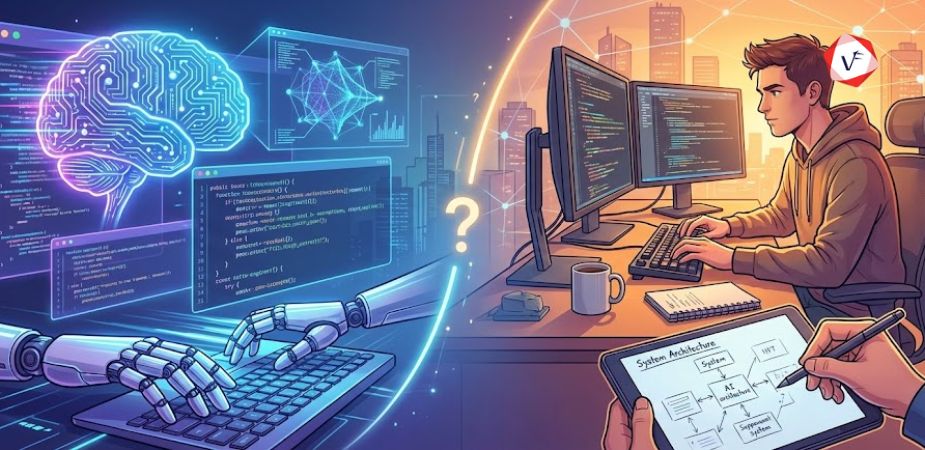
Can AI Outperform Human Software Engineers?
Quick Answer: AI cannot currently outperform human software engineers across the full spectrum of development activities. While AI excels at code generation and bug detection, it struggles with creativity, critical thinking, and complex problem-solving. Surprisingly, research shows developers using AI tools are 19% slower than working without them, despite perceiving productivity gains.
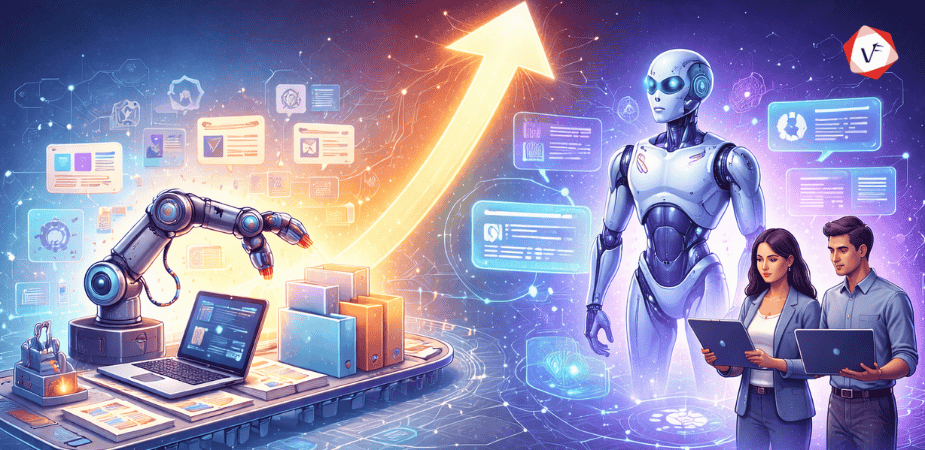
The question of whether artificial intelligence can outperform human software engineers has become increasingly pertinent as AI-powered development tools gain widespread adoption across the technology industry. With Gartner predicting that by 2028, 90% of enterprise software engineers will use AI code assistants, up from less than 14% in early 2024, the relationship between AI and human developers is rapidly transforming.
This transformation raises fundamental questions about the capabilities, limitations, and future roles of both artificial intelligence and human software engineers in creating robust, innovative software solutions. Understanding this dynamic is crucial for organizations, developers, and technology leaders as they navigate the implications of AI integration in software development processes.
The Current State of AI in Software Development
AI Capabilities in Modern Software Engineering
Artificial intelligence has made remarkable strides in software engineering, with AI-powered tools now capable of performing various development tasks that were once exclusively human domains. AI-powered tools can automatically generate code snippets, perform code refactoring, and assist in bug detection and fixing, demonstrating tangible capabilities in routine programming activities.
The integration of AI in software engineering spans multiple phases of the development lifecycle. The integration of AI enhances productivity, improves code quality, and accelerates development cycles. Key areas of impact include:
- Automated code generation: Creating boilerplate code and standard implementations
- Intelligent debugging: Identifying potential errors and suggesting fixes
- Predictive maintenance: Anticipating system failures and maintenance needs
- Testing automation: Generating test cases and identifying edge cases
These capabilities suggest that AI can indeed handle certain aspects of software engineering with considerable effectiveness.
Real-World Performance Limitations
Key Research Finding: New OpenAI research shows AI models like Claude 3.5 solve fewer than half of real-world software engineering tasks from a $1M benchmark, indicating significant limitations when AI systems encounter complex, real-world programming challenges that go beyond straightforward coding exercises.
Surprising Research Findings on AI Performance
The Productivity Paradox
Recent studies have uncovered unexpected results regarding AI’s impact on software engineering productivity. When developers use AI tools, they take 19% longer than without—AI makes them slower, according to a randomized controlled trial examining experienced open-source developers working on their own repositories. This finding challenges the common assumption that AI tools automatically boost developer productivity.
Perception vs. Reality Gap
The disconnect between perception and reality is particularly striking. When people estimated that AI had increased their productivity by 20 percent, they were actually experiencing decreased efficiency. This suggests that the subjective experience of using AI tools may not align with objective productivity measurements, highlighting the importance of rigorous evaluation when assessing AI’s contribution to software engineering.
These research findings indicate that while AI tools may feel helpful and provide immediate assistance, they may introduce overhead that ultimately slows down experienced developers. The reasons for this productivity decrease could include:
- Time spent reviewing AI-generated code for accuracy and quality
- Correcting logical errors that appear syntactically correct
- Adapting AI suggestions to fit specific project requirements
- Validating edge cases and error handling
- Ensuring compliance with organizational coding standards
Areas Where Human Software Engineers Excel
Creative Problem-Solving and Innovation
Human software engineers possess several distinctive capabilities that current AI systems struggle to replicate effectively. Human engineers continue to excel in unique problem-solving areas that AI struggles to replicate. Human intuition and creativity are especially valuable when solving complex or edge-case problems, demonstrating the irreplaceable value of human cognitive abilities in software engineering.
Critical thinking and innovation represent fundamental human advantages in software engineering. AI is unable to think critically and generate new ideas—it can only repeat ideas based on the data it’s been trained on. Critical thinking and problem-solving are important programming skills that AI cannot replicate. This limitation becomes particularly apparent when software engineers need to:
- Architect novel solutions for unprecedented challenges
- Design innovative system frameworks
- Address unique technical problems without established patterns
- Create breakthrough approaches to complex issues
Business Context and Strategic Thinking
Human software engineers also excel in understanding business context, stakeholder requirements, and the broader implications of technical decisions. They can navigate ambiguous requirements, make strategic trade-offs, and consider long-term maintainability in ways that current AI systems cannot match. The ability to communicate with non-technical stakeholders and translate business needs into technical solutions remains a distinctly human capability.
Domain Expertise and Adaptability
Furthermore, human software engineers bring domain expertise, industry knowledge, and the ability to learn from experience in ways that transcend pattern matching. They can adapt to changing technologies, methodologies, and business requirements with flexibility that AI systems currently lack.
AI Limitations & Reliability Concerns
Code Quality and Accuracy Issues
Despite impressive capabilities in certain areas, AI systems face significant limitations that impact their reliability in software engineering applications. AI is prone to hallucinations, which can result in the generation of incorrect or misleading code that appears syntactically correct but contains logical errors or security vulnerabilities.
The reliability concerns extend beyond simple coding errors. AI systems may generate code that:
- Works in limited test cases but fails under edge conditions
- Exhibits poor performance characteristics
- Introduces subtle bugs that become apparent only in production environments
- Contains security vulnerabilities that aren’t immediately obvious
These issues require human software engineers to carefully review and validate AI-generated code, potentially offsetting productivity gains.
System-Level Understanding Gaps
Another significant limitation involves AI’s inability to understand the broader context of software systems. While AI can generate individual functions or code snippets effectively, it struggles with system-level architecture decisions, cross-component interactions, and the complex dependencies that characterize real-world software applications.
AI systems also face challenges in maintaining consistency across large codebases, understanding project-specific conventions, and adhering to organizational coding standards. These limitations require human oversight and intervention, highlighting the continued necessity of human software engineers in ensuring code quality and maintainability.
The Collaborative Future: AI & Human Partnerships
Augmentation Over Replacement
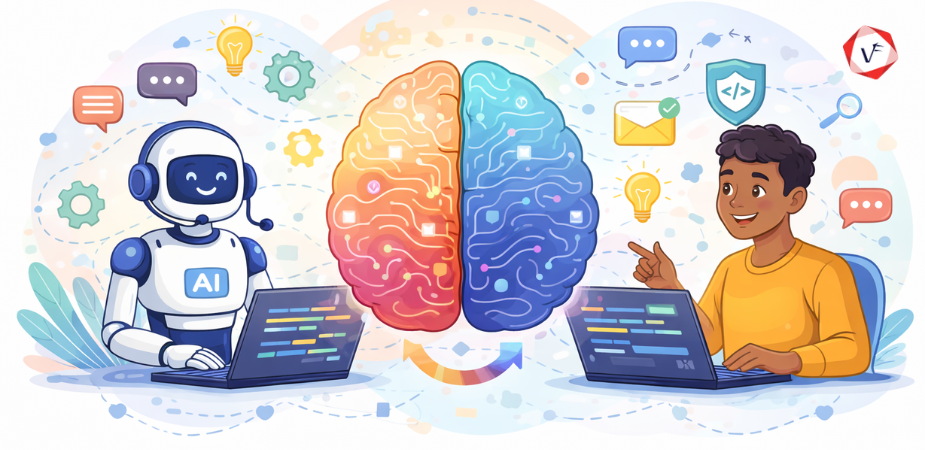
Rather than viewing AI as a replacement for human software engineers, the evidence suggests a collaborative future where AI and human capabilities complement each other. While AI has the potential to automate many programming tasks, up to 80% of programming jobs will remain human-centric, indicating that human software engineers will continue to play essential roles in software development.
Agentic Software Engineering Model
The rise of agentic software engineering represents an approach where AI systems can handle increasingly sophisticated tasks while human software engineers focus on higher-level design, architecture, and strategic decision-making. This partnership model leverages AI’s strengths in pattern recognition and code generation while preserving human expertise in creativity, critical thinking, and contextual understanding.
Optimal Division of Labor
The most effective implementations of AI in software engineering appear to involve AI systems handling routine, repetitive tasks while human software engineers concentrate on complex problem-solving, system design, and innovation. This division of labor allows both AI and human capabilities to be utilized optimally, potentially achieving better outcomes than either could produce independently.
Organizations that successfully integrate AI into their software development processes tend to focus on augmentation rather than replacement, using AI tools to enhance human productivity while maintaining human oversight and decision-making authority for critical aspects of software engineering.
Industry-Specific Performance Variations
Financial Services and Healthcare
The performance gap between AI and human software engineers varies significantly across different industry sectors and application domains. In financial services, human software engineers consistently outperform AI systems when developing trading algorithms, risk management systems, and compliance-focused applications that require deep understanding of regulatory requirements and market dynamics. The complexity of financial regulations and the need for precise mathematical modeling create scenarios where human expertise remains indispensable.
Healthcare software development presents another domain where human software engineers demonstrate clear superiority over AI systems. Medical software requires understanding of clinical workflows, patient safety protocols, and healthcare regulations that AI systems struggle to comprehend fully. Human software engineers working on electronic health records, medical imaging software, and telemedicine platforms bring domain knowledge that enables them to create solutions that meet both technical and clinical requirements effectively.
Areas Where AI Shows Stronger Performance
Conversely, AI systems show stronger performance in certain specialized areas such as:
- Data processing applications with established patterns
- Routine web development tasks using standard frameworks
- Standardized API implementations
- Boilerplate code generation
These domains benefit from AI’s pattern recognition capabilities and ability to generate code based on established templates and frameworks. However, even in these areas, human software engineers remain necessary for quality assurance, performance optimization, and ensuring the generated code meets specific business requirements.
Gaming and Enterprise Software
The gaming industry illustrates another interesting performance dynamic. While AI can assist with procedural content generation and basic gameplay mechanics, human software engineers excel at creating engaging user experiences, implementing complex game logic, and optimizing performance across diverse hardware platforms. The creative aspects of game development, including narrative integration and innovative gameplay features, remain firmly in the human domain.
Enterprise software development represents a particularly challenging area for AI systems. Human software engineers consistently outperform AI when building large-scale enterprise applications that require integration with existing systems, consideration of organizational workflows, and accommodation of complex business rules. The ability to understand stakeholder requirements, navigate enterprise politics, and design scalable architectures gives human software engineers significant advantages in this sector.
Final Thoughts: Key Takeaways
The evidence clearly indicates that while AI has made significant contributions to software engineering, it cannot currently outperform human software engineers across the full spectrum of development activities. AI excels at specific tasks like code generation and bug detection, but struggles with creativity, critical thinking, and complex problem-solving that human software engineers handle naturally.
The surprising research showing decreased productivity when developers use AI tools underscores the complexity of this technological integration. The future likely belongs to collaborative partnerships where AI augments human capabilities rather than replacing them entirely.
Key Insights:
- AI tools make developers 19% slower despite perceived productivity gains
- 80% of programming jobs will remain human-centric
- Human engineers excel at creativity, critical thinking, and business context
- AI struggles with system-level architecture and novel problem-solving
- The optimal approach combines AI automation with human oversight
For organizations seeking to harness both AI potential and human expertise effectively, Vofox AI solutions provider offers comprehensive solutions for navigating this technological transformation successfully. Drop us a message for more information.