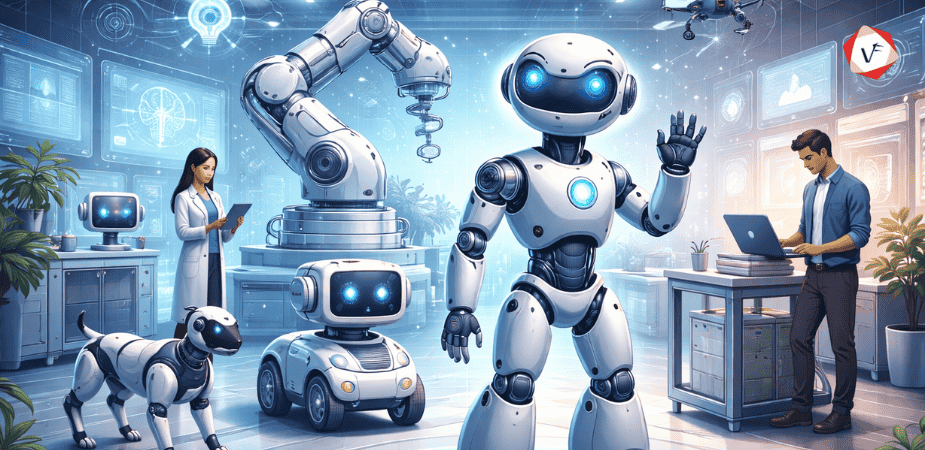
There’s a version of AI that doesn’t just answer questions — it picks things up, walks through a warehouse, installs components on a factory line, or sets a table. It exists in physical space, makes decisions in real time, and adapts when something unexpected happens. This is what people in the field are calling Physical AI, and if the chatbot era felt like a big deal, this next phase is something else entirely.
I want to be clear upfront: we’re still early. Some of the hype around humanoid robots specifically is running ahead of reality in ways worth discussing honestly. But the underlying shift is real — and understanding it now matters whether you’re a business leader, a developer, or just someone trying to make sense of where this technology is heading.
What exactly is Physical AI?
The term gets used loosely, so it’s worth grounding it a bit. Physical AI refers to AI systems that are embedded in physical machines — robots, vehicles, autonomous devices — and that can perceive their environment, make decisions, and act on the world around them. Not just process text or generate images, but actually do things in three-dimensional space.
NVIDIA helped popularize the phrase, but the concept predates the label. What’s new isn’t the idea of robots using AI — that’s been around in research labs for decades. What’s new is that the AI powering these systems has gotten dramatically better, very quickly. The same large language model capabilities that make a chatbot feel surprisingly coherent are now being connected to sensors, actuators, and mechanical bodies. The result is machines that can adapt to environments that weren’t pre-programmed for them.
Think about what that means in practice. Traditional industrial robots are great at repetitive, predictable tasks in controlled environments. They weld the same joint, in the same spot, thousands of times a day. Move something six inches to the left without telling the robot? It fails. Physical AI changes that equation — at least in theory. The goal is machines that can handle variability, ambiguity, and the general messiness of real-world environments.
From chatbots to embodied machines: why the jump is bigger than it looks
Here’s something that surprised me when I started paying closer attention to this space: the distance between a really good chatbot and a functional physical robot is enormous. The software intelligence behind them may be related, but the engineering challenges are almost completely different.
A language model deals with tokens. A physical robot deals with gravity, friction, weight distribution, motor control, real-time sensor data, battery drain, and a world that doesn’t wait for the AI to finish processing. Getting a robot to reliably pick up an object of unknown weight from an unusual angle — something a five-year-old does without thinking — is genuinely hard. It’s taken enormous investment and still isn’t solved at scale.
That said, recent progress has been real. Humanoid robots have moved beyond laboratory demonstrations to active pilot programs in warehouses and factories, now able to navigate unstructured environments, climb stairs, open doors, and manipulate objects — without the rigid, line-by-line programming that limited earlier generations. That’s a meaningful jump.
What made it possible? A few things converging at once:
- Vision-Language-Action (VLA) models — AI systems that connect visual perception, language understanding, and physical action in a unified framework. The robot sees something, understands what it is, and knows what to do with it.
- Better simulation environments — Robots can now practice millions of scenarios in simulated environments before ever touching the real world. A robot can practice millions of grasp attempts in simulation overnight, then apply that knowledge in a physical setting the next day — dramatically accelerating the learning process and reducing training costs.
- Cheaper hardware — Sensors, actuators, and processors that used to cost a small fortune are becoming accessible. Goldman Sachs reports that humanoid manufacturing costs dropped 40% between 2023 and 2024.
Where it’s already working — and where it isn’t
Let’s be specific, because the general claims about “robots taking over everything” tend to obscure what’s actually happening on the ground.
Logistics and warehousing are the clearest success story right now. Amazon’s “Sequoia” system increased warehouse efficiency by 75%, and the company’s fleet of over 1 million robots is expected to handle 75% of its global deliveries by mid-2026. That’s not prototype territory — that’s operational reality.
Manufacturing is seeing real traction too. CATL has introduced humanoid robots in its battery manufacturing lines, achieving 99% reliability when inserting connectors into battery packs and matching human speeds even when working with challenging, flexible cables. That kind of precision, in that kind of environment, is genuinely impressive.
Surgical robotics has been quietly evolving for years. Robotic surgeries now account for 60% of procedures in major hospitals, with systems like Intuitive Surgical’s da Vinci 5 leading the market — a platform with computing power 10,000 times greater than its earlier models.
But here’s where I’d pump the brakes a little: humanoid robots as general-purpose workers are still more pilot program than production reality. In 2025 we saw the prototypes. In 2026, we are seeing pilots turn into production reality — but that’s different from widespread deployment. The honest picture is that purpose-built, specialized robots still dramatically outperform humanoid designs in most industrial settings. Boston Dynamics’ Stretch robot has proven its worth unloading containers faster than humans and is already used in GAP warehouses — but it’s designed for that one job, not general labor.
The gap between what works in a demo and what works reliably at scale is real, and anyone telling you it’s already been closed is probably selling something.
The sim-to-real gap nobody talks about enough
There’s a specific challenge in robotics that I think deserves more honest attention than it usually gets.
Training a robot in simulation is now feasible and increasingly common. The problem is what happens when that robot encounters the real world. The “sim-to-real” gap — where robots perform with 95% accuracy in labs but drop to 60% in real-world conditions — highlights the difficulty of transitioning from controlled environments to practical deployment. That 35-point drop matters enormously when you’re talking about a machine operating around people.
The real world is messy in ways simulation struggles to replicate. Lighting changes. Objects are placed slightly differently than expected. Surfaces have unexpected textures. A cable hangs where it wasn’t last week. A human worker reaches into the robot’s path at the wrong moment. These edge cases are exactly the situations where today’s systems tend to fail, and they’re also exactly the situations that matter most for safety.
This isn’t a reason to dismiss the technology — it’s a reason to be thoughtful about where and how it gets deployed. The most successful implementations right now tend to be in structured environments where variability is controlled, not in the fully unstructured settings that make for better press releases.
What does this actually mean for businesses?
If you’re running a business and trying to figure out whether and how Physical AI applies to you, here’s a more grounded way to think about it than the usual hype cycle suggests.
The first question isn’t “how do I deploy robots?” It’s: “which parts of our operations involve repetitive, physically demanding, or dangerous work that happens in a reasonably predictable environment?” Those are the use cases where automation is viable now. Think about warehouse picking, quality inspection, material transport, certain assembly tasks.
The second question is about integration. You cannot plug a 2026 humanoid robot into a 1990s Excel spreadsheet. You need a unified data platform to orchestrate your fleet. This is actually one of the more underappreciated challenges — the robot hardware gets the attention, but the software infrastructure, data pipelines, and integration work are often where projects succeed or fail.
For companies that aren’t ready to own a robotics fleet outright, Robotics-as-a-Service (RaaS) models are emerging as a way to minimize upfront investment while still accessing the technology. Instead of a six-figure capital expenditure, you pay for utilization. That changes the calculus significantly for mid-sized businesses.
The software layer matters more than people realize, which is exactly where companies like Vofox come in. Building the AI systems, data pipelines, and custom integrations that connect robotics hardware to actual business workflows is specialized work. If you’re evaluating a physical AI deployment, Vofox’s AI development team has the technical depth to help you build those connections the right way, rather than bolting something together and hoping it holds.
The honest timeline: what to expect and when
I’ve seen timelines for this technology get wildly optimistic, so here’s a more grounded read based on where things actually stand in 2026.
Right now, industrial and logistics deployments are the real story. Warehouses, manufacturing, surgical systems — these are working, scaling, and generating genuine ROI. If your business touches these sectors, this is worth paying attention to now, not in five years.
In the 2027–2030 window, expect meaningful expansion of humanoid robots in commercial settings, continued cost reductions, and the first serious consumer deployments. Most industry analysts expect general-purpose humanoid robots to reach the $20,000–$30,000 range by 2030 through manufacturing scale and component cost reductions. That’s still not cheap, but it’s a different conversation than today’s entry-level price of $150,000+ for capable platforms.
Beyond 2030, the scenarios get genuinely transformative — and also more speculative. Goldman Sachs projects that the global humanoid robot market could reach $38 billion by 2035. Demographic pressures (aging populations, labor shortages in certain sectors) are a real structural driver here. The case for physical AI isn’t just “it’s cool technology” — it’s that some industries genuinely face workforce gaps that automation can address.
The more interesting question might not be when but which — which industries, which use cases, which geographies move first? Manufacturing and logistics in Asia and North America are already the early battlegrounds. Healthcare is close behind. Consumer settings are real but further out than the headlines suggest.
Quick answers: Physical AI questions people actually ask
What’s the difference between a regular robot and a Physical AI robot?
Traditional robots follow fixed, pre-programmed instructions. A Physical AI robot uses machine learning to perceive its environment and adapt its behavior in real time — like the difference between a calculator and something that can reason.
Is Physical AI the same as humanoid robots?
Not exactly. Humanoid robots (those designed to look and move like humans) are one category of Physical AI, but not all of it. Autonomous vehicles, robotic arms that learn new tasks, and AI-guided surgical systems are all Physical AI — most of them don’t look remotely human.
How much do commercial humanoid robots cost right now?
As of 2026, commercial humanoid robots range from $13,500 for entry-level platforms like the Unitree G1 to $250,000+ for systems like Agility Robotics’ Digit. Pricing varies enormously based on capability, payload, and intended use case.
Which companies are leading the Physical AI space?
It’s a genuinely competitive field. Tesla (Optimus), Figure AI, Agility Robotics, Boston Dynamics, and a strong cohort of Chinese manufacturers — including Unitree, AgiBot, and Fourier — are among the most active. China dominated with roughly 90% of global humanoid shipments in 2025. On the infrastructure side, NVIDIA is playing a foundational role through simulation platforms and AI chips.
What are the biggest limitations of Physical AI right now?
Most humanoid platforms still struggle with an operational ceiling of three to four hours, and the dexterity required for delicate tasks — like threading a needle or handling fragile items — still lags behind human capability. Real-world reliability and the sim-to-real gap are the honest limiting factors. The field is advancing quickly, but those challenges are real.
When will Physical AI affect everyday consumer life?
Realistically, meaningful consumer deployments — household robots doing useful things reliably — are more a 2028–2030 story than a 2026 one, despite the excitement. The infrastructure, safety standards, and price points aren’t there yet for mass adoption.
The part that doesn’t get discussed enough
Most coverage of Physical AI focuses on the machines. The hardware. The demos. The funding rounds. What gets less attention is the software and systems work that actually makes any of this usable in a real business context.
A humanoid robot that can walk is impressive. A humanoid robot that’s connected to your inventory management system, your safety protocols, your shift scheduling software, and your QA pipeline — that’s a deployment. Those two things are very different problems. The second one is where most of the actual work happens, and it requires people who understand both AI systems and the specific operational context deeply.
That’s been true of every major technology transition. The chatbot era created enormous value not just through the models themselves but through the applications, integrations, and workflows built around them. Physical AI will follow the same pattern — the robots are the hardware layer, but the intelligence, the integration, and the real-world utility live in the software.
If your organization is starting to think seriously about where AI goes beyond the screen, the smartest next step is probably a direct conversation with people who’ve already built these systems. Vofox’s AI practice works with businesses at exactly this intersection — where the technology is real, the use cases are specific, and the implementation details actually matter.