An AI agent can impress everyone in a demo and still fail when a business puts it to work. It might answer questions accurately but struggle to retrieve CRM records, access ERP data, or coordinate tasks with another AI agent. These failures can lead to unexpected integration work, delays, and additional maintenance costs.
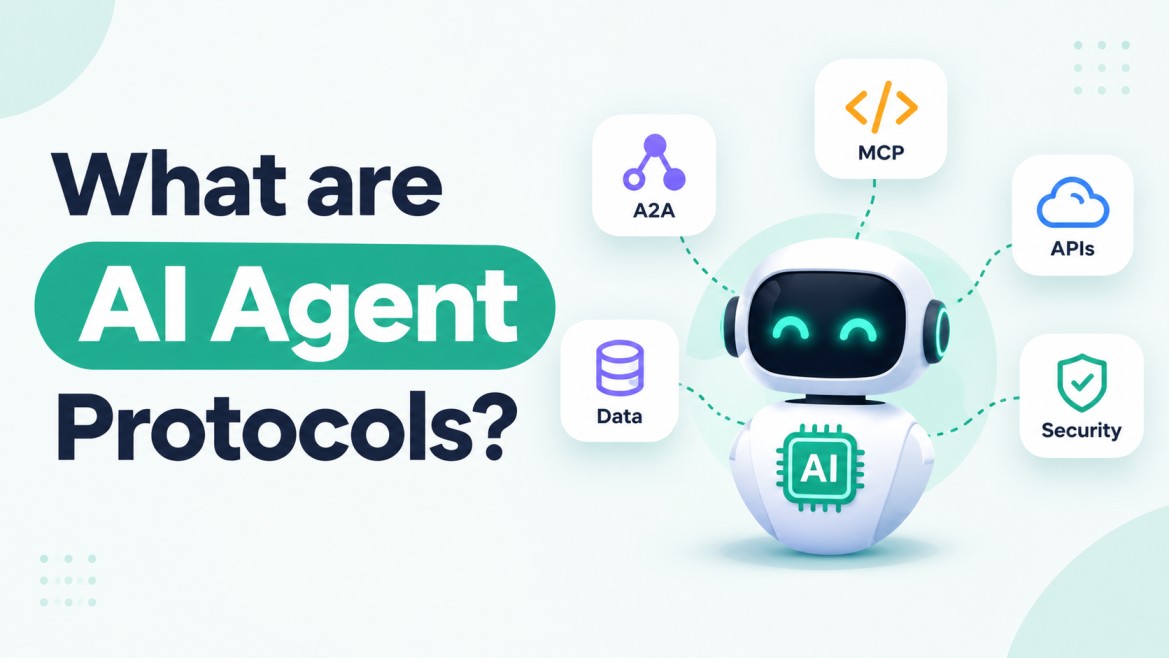
AI agent protocols define how AI systems connect to tools and data sources and communicate with other agents. They establish shared rules for interactions, helping independently developed systems work together without requiring a custom integration for every connection.
Two protocols are especially relevant to businesses exploring agentic systems. The Model Context Protocol (MCP) connects AI applications with tools and context. The Agent2Agent (A2A) protocol enables communication between AI agents.
Understanding these protocols can help businesses assess an AI development company beyond its demos and technical promises. Before investing in AI agent development services, learn what MCP and A2A do, where each fits, and how to evaluate a development partner’s expertise.
Understanding AI agent protocols: MCP, A2A, and their business applications
AI agent protocols give AI systems an agreed method for exchanging requests, results, and capability information.
How AI agent protocols work?
A protocol defines how one party makes a request, how the other responds, and how each side learns what the other can do. Depending on the protocol, that includes message formats, capability discovery, and task handling. Both MCP and A2A build on established messaging standards such as JSON-RPC, a lightweight format for structured requests and responses.
An AI model, an AI agent, an API, an orchestration framework, and a protocol each do a different job:
- AI model: the language model that reasons and generates text.
- AI agent: software that uses a model to plan and take actions toward a goal.
- API: a specific interface to one specific service.
- Orchestration framework: a toolkit, such as LangGraph or CrewAI, for building and coordinating agents.
- Protocol: a shared rulebook that many different implementations can follow.
A protocol sits between these layers and replaces none of them. The A2A documentation describes the same layering: frameworks build agents, MCP gives them context, and A2A connects them to other agents.
Model Context Protocol (MCP)
MCP is an open-source standard for connecting AI applications to external systems, including data sources, tools, and workflows. A host application creates one MCP client for each MCP server, and each server exposes context or capabilities to its client.
For businesses, this means an AI application can reach internal databases, ticketing systems, or file stores through a common interface. Where compatible implementations exist, teams write fewer bespoke connectors. Integrations also become easier to maintain and extend.
MCP does not guarantee security, compatibility, or smooth integration. Permissions, authentication, and the surrounding architecture still decide the outcome. The MCP project’s security best practices warn about risks such as misused credentials and over-trusted tokens.
Agent2Agent (A2A) protocol
A2A is an open standard that lets AI agents built on different frameworks, or supplied by different providers, discover each other and collaborate on tasks. Google originated the protocol, and in August 2026 it joined the Agentic AI Foundation, which also hosts MCP.
Agents publish an Agent Card that describes their capabilities and how to contact them. A client agent can then delegate a task, receive status updates, and collect results, including for long-running work. Agents keep their internal logic private during this exchange.
A2A does not replace every API, orchestration system, or integration method. A single agent that only calls internal services may never need it.
MCP vs. A2A
MCP and A2A address different interaction needs, and the A2A project’s MCP comparison describes them as complementary.
MCP and A2A address different interaction needs, and the A2A project’s MCP comparison describes them as complementary.
- Primary purpose: MCP connects an AI application to external tools, data sources, and context. A2A lets independent agents discover each other, delegate tasks, and collaborate.
- Main interaction: In MCP, a host application runs clients that call MCP servers to read context or run tools. In A2A, a client agent sends a task to a remote agent, which reports status and returns results.
- Business application: Example with MCP: a support assistant reads order data and creates a ticket through servers linked to the order system and helpdesk. Example with A2A: a support agent delegates a refund-policy check to a finance agent that another team operates.
- Typical use case: MCP suits an agent that needs governed access to internal systems and data. A2A suits several specialized agents, possibly from different vendors, that must coordinate one workflow.
One architecture can use both: each agent uses MCP to reach its own tools and data, and A2A to work with other agents.
Consider a hypothetical customer support scenario, offered as an example rather than a verified deployment. An agent retrieves order history and policy documents through MCP-compatible integrations. When a customer disputes a charge, it delegates the case through A2A to a billing agent built by another team on a different framework.
The billing agent reports task status and returns a result. Software development, where a coding agent reads a repository through MCP, and internal knowledge retrieval follow the same pattern.
Protocol decisions shape integration effort, maintainability, flexibility, security planning, and future expansion. A proprietary connector for every tool can mean rework when the next agent arrives.
Key factors to evaluate when choosing an AI development company for Agentic AI
Evaluate an AI development company on technical depth across eight factors, and ask for evidence on each one.
- Protocol knowledge and implementation experience.
Ask whether the team understands MCP, A2A, and other relevant integration standards. Request concrete examples of comparable implementations instead of accepting broad claims of expertise.
2. Integration with existing systems
Check whether the team can connect agents to your applications, APIs, data sources, identity systems, and business workflows. Strong AI agent development services start from the systems you already run.
3. Architecture and interoperability
Confirm that the proposed architecture supports the agent interactions you need. It should avoid unnecessary dependence on one framework or vendor.
4. Security and access control
Examine authentication, authorization, least-privilege permissions, sensitive-data handling, tool access limits, auditability, and safeguards against unsafe agent actions. Protocol support alone does not establish security.
5. Scalability and maintainability
Ask how the solution will handle growing workloads, additional agents, evolving integrations, version changes, testing, monitoring, and ongoing maintenance.
6. Business alignment and measurable outcomes
Check that technical decisions tie to specific goals, such as fewer manual handoffs, better workflow completion, or simpler system integration. Be cautious of savings promises that lack evidence.
7. Testing and failure handling
Ask how the team tests protocol compatibility, handles unavailable tools or agents, manages timeouts and errors, and monitors agent interactions in production.
8. Documentation and long-term support
Review the quality of technical documentation, handover processes, maintenance arrangements, and plans for future changes.
The right protocols depend on your use case, existing architecture, security requirements, and ecosystem. A capable AI development partner recommends what fits those conditions, not what is merely popular.
Use these questions in vendor conversations:
- Which protocols do you recommend for this use case, and why?
- Can you show a comparable integration you built and what you changed after testing it?
- How do you handle authentication and permissions between agents, tools, and our identity systems?
- What happens when a tool or agent times out or returns an error?
- How do you test compatibility when a protocol version changes?
- What documentation and handover will we receive?
- How would we replace a framework or vendor later?
Vofox’s artificial intelligence services cover natural language processing, machine learning, computer vision, and chatbots. Its software consulting services include integrating data and AI models into existing systems, which speaks to the integration factor above.
Vofox also describes an AI project process that moves from defining the business problem to a feasibility study and a proof of concept. For agentic projects, a proof of concept is a sensible place to test protocol choices before full development begins.
Protocol-specific experience still needs confirming. Ask any shortlisted AI development partner, Vofox included, which protocols it would recommend for your use case and which comparable integrations it has built.
Your use case sets the shortlist: which systems agents must reach, which agents must collaborate, and which security rules apply. Test each candidate against those requirements before you commit.
Final takeaway
Choose the AI development partner that can explain its protocol decisions, not just demonstrate a polished agent. AI agent protocols shape how easily an agent reaches your systems, how safely it acts, and how well it adapts as your needs grow. Before you sign, ask for a comparable integration, a walkthrough of the security design, and a plan for handling failures.
A Vofox analyst starts by gathering your requirements in detail. The team gathers the details of your AI use case, prepares a budget estimate and timeline, and signs an NDA once you approve the estimate.
Discuss your AI agent requirements with the Vofox team.
FAQs
-
What are AI agent protocols and why are they important for business?
AI agent protocols are standardized rules for how AI agents connect to tools, data, and other agents. They matter because shared rules reduce custom integration work, let systems interoperate, and make coordinated AI workflows easier to maintain over time.
-
What is the difference between MCP and A2A protocols?
MCP connects AI applications to tools and data, while A2A lets AI agents communicate and collaborate with each other. MCP handles access to context and actions. A2A handles task delegation and status sharing between agents. Many systems use both.
-
Should businesses check AI protocols expertise when hiring an AI development company?
Yes, businesses should check protocol expertise when hiring an AI development company. Protocol knowledge helps reveal whether a team can integrate agents with existing systems, design interoperable architecture, and apply security controls. Weigh it alongside testing and business requirements.
-
Which AI agent protocols should businesses know about?
MCP and A2A are the two main AI agent protocols businesses should know. MCP connects agents to tools and data. A2A connects agents to other agents. Businesses should choose protocols that fit their use case and security needs.
-
How do AI agent protocols help businesses?
AI agent protocols help businesses connect AI systems with less custom integration work. They support interoperability, coordinated multi-agent workflows, and easier long-term maintenance. Results still depend on implementation quality, security design, and architectural fit for the use case.