As businesses grow, managing daily operations, customer expectations, and increasing workloads becomes more challenging. Manual processes often slow down productivity. Traditional automation also struggles when tasks require contextual understanding, continuous learning, or independent decisions. AI agents can address these challenges by handling complex workflows and supporting faster business decisions. However, implementing this technology requires careful consideration of business needs, operational goals, and existing systems. Recognizing the right time to adopt AI agents helps organizations improve efficiency and manage resources effectively. Working with the best AI development company can help businesses identify suitable opportunities, select the right technology, and implement solutions that deliver measurable results.
Key Signs Your Business Needs AI Agent Automation
Recognizing operational challenges early helps businesses determine whether AI agents can improve their workflows. Several signs indicate that your organization may benefit from this technology.
- Repetitive tasks consume valuable employee time
When employees spend hours handling repetitive activities, they have less time for strategic responsibilities. Tasks such as data entry, appointment scheduling, invoice processing, and customer inquiries can create unnecessary workloads. AI agents can manage these activities with minimal human intervention. This allows employees to focus on higher-value business priorities.
- Your customer support team struggles with increasing requests
Growing customer inquiries can overwhelm support teams, especially when customers expect immediate responses. Delayed replies, unresolved tickets, and inconsistent communication can affect customer satisfaction. AI agents can understand customer questions, retrieve relevant information, and provide contextual responses. They can also escalate complicated requests to human representatives.
- Your business struggles with disconnected workflows
Many organizations use separate applications for sales, marketing, finance, and customer management. Employees often move information between these systems manually. This creates delays and increases the possibility of errors. AI agents can coordinate activities across connected platforms and maintain consistent information throughout business workflows.
- Decision-making takes too long
Businesses often collect substantial amounts of information without extracting useful insights quickly. Teams may struggle to identify patterns, monitor performance, and respond to changing conditions. AI agents can analyze available data, generate recommendations, and support informed decisions.
- Your existing automation cannot handle complex situations
Traditional automation follows predefined instructions. It may struggle when workflows involve changing conditions or unexpected requests. AI agents can interpret context, evaluate available information, and select appropriate actions within defined permissions.
If these challenges affect daily operations, consulting the best AI development company can help determine whether AI agents offer a practical solution.
How AI Agents Improve Business Process Efficiency and Decision-Making
AI agents help organizations manage complex business activities while improving operational consistency. They combine artificial intelligence, data processing, and decision-making capabilities to perform tasks with limited human supervision.
- Streamlining complex business workflows
AI agents can coordinate multiple activities across different departments. For example, a sales agent can qualify incoming leads, update customer records, schedule follow-ups, and notify sales representatives. These connected activities reduce manual coordination and help employees maintain consistent workflows.
Businesses can also use agents to manage document processing, inventory monitoring, and internal requests. Their ability to handle multiple workflow stages improves operational speed. Teams can complete routine responsibilities with fewer interruptions.
- Improving customer experiences
Customer expectations continue to increase as digital services become more accessible. AI agents can provide continuous assistance by answering questions, checking order information, and guiding customers through common processes.
They can also use conversation history and available customer information to deliver relevant responses. When an inquiry requires specialist attention, agents can transfer the conversation to an appropriate employee. This approach helps businesses maintain responsive customer support without increasing staffing requirements proportionally.
- Supporting faster and informed decisions
AI agents can examine large datasets and identify patterns that employees might overlook. They can monitor sales performance, evaluate customer behavior, and identify operational bottlenecks. Businesses can use these insights to adjust strategies and prioritize important activities.
For instance, an inventory management agent can monitor stock levels and identify products that require replenishment. It can notify purchasing teams before shortages affect business operations.
- Reducing operational costs and improving resource allocation
AI agents can reduce the time employees spend on repetitive responsibilities. They also help organizations minimize avoidable processing errors and improve resource utilization.
Businesses should establish clear performance indicators before implementation. Metrics such as processing time, response speed, error rates, and employee productivity help measure improvements. Partnering with the best AI development company also helps organizations build solutions around measurable operational objectives.
AI Agents vs Traditional Automation: Choosing the Right Solution for Your Business
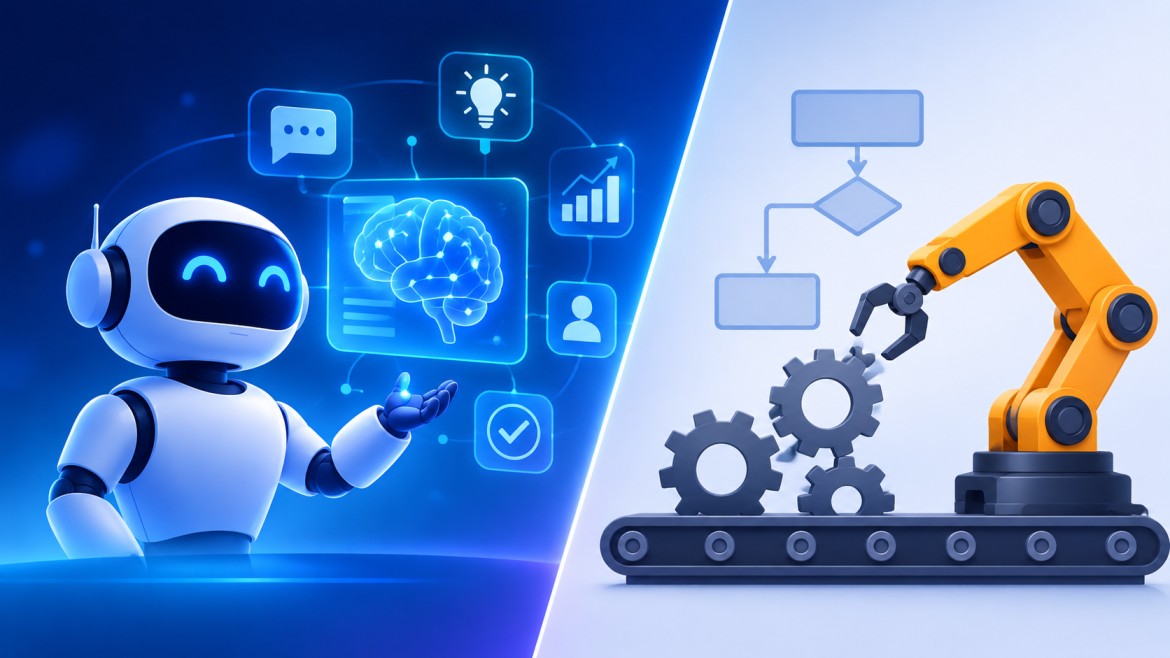
Businesses should understand the differences between AI agents and traditional automation before investing in either solution. Both technologies improve operational efficiency, but they address different requirements.
Understanding traditional automation
Traditional automation uses predefined rules, triggers, and workflows to execute repetitive tasks. For example, an organization can configure its CRM system to send automatic emails after customers submit inquiry forms.
These systems perform reliably when tasks follow predictable patterns. However, they require manual adjustments when business rules change. They also struggle with ambiguous information and situations that require contextual decisions.
Understanding AI agents
AI agents use artificial intelligence to interpret information, evaluate situations, and determine suitable actions. They can process natural language, retrieve relevant information, and adapt their responses according to available context.
For example, an AI customer service agent can understand different versions of the same question. It can retrieve relevant account information, suggest solutions, and escalate unresolved issues. Businesses can define permissions and approval requirements to maintain appropriate human oversight.
How to choose the right solution
The right approach depends on workflow complexity, business objectives, and available resources.
- Choose traditional automation: When your processes follow stable rules and involve predictable, repetitive activities.
- Choose AI agents: When workflows require contextual understanding, multiple decisions, and coordination across different systems.
- Consider a hybrid approach: When your business needs reliable rule-based execution alongside intelligent decision-making.
A specialized AI development company can evaluate your existing infrastructure and recommend suitable technologies. Professional AI development services can also help businesses integrate agents with existing applications, establish security controls, and monitor performance.
Organizations should evaluate scalability, integration requirements, implementation costs, and expected returns before making a decision. The best AI development company will also help establish clear governance practices and measurable success criteria.
Conclusion
Identifying when your business needs AI agents starts with understanding existing operational challenges. Repetitive workloads, increasing customer requests, disconnected systems, and delayed decisions can indicate opportunities for intelligent automation. AI agents can help organizations improve productivity, strengthen customer experiences, and manage complex workflows more effectively. However, successful implementation requires clear objectives, suitable technology, and proper integration with existing systems. Businesses should assess their requirements and identify processes where intelligent assistance can deliver measurable value. Partnering with the best AI development company can simplify this process through tailored solutions, technical expertise, and ongoing support. A well-planned implementation helps organizations build efficient operations and prepare for future business demands.
Frequently Asked Questions
- What are the common signs that a business needs an AI agent?
Common signs include repetitive manual tasks, increasing customer support requests, disconnected workflows, delayed decision-making, and limited automation capabilities. Businesses experiencing these challenges can evaluate AI agents to improve operational efficiency and reduce employee workloads.
- How can AI agents improve business productivity and operational efficiency?
AI agents automate repetitive activities, coordinate workflows, analyze business information, and support faster decisions. They also help employees focus on strategic responsibilities while maintaining consistent execution across different business processes.
- Which business processes can be automated using AI agents?
Businesses can use AI agents for customer support, lead qualification, appointment scheduling, document processing, invoice management, inventory monitoring, data analysis, and internal workflow coordination. The most suitable processes depend on operational requirements and system integration capabilities.
- What is the difference between AI agents and traditional automation?
Traditional automation follows predefined rules to complete predictable tasks. AI agents interpret context, analyze information, and determine appropriate actions based on their objectives and permissions. AI agents generally suit workflows that involve complex decisions and changing conditions.
- How can businesses evaluate the ROI of implementing AI agents?
Businesses can evaluate ROI by comparing implementation and maintenance costs against measurable operational benefits. Important indicators include reduced processing time, lower operational expenses, improved customer response rates, fewer errors, and increased employee productivity.