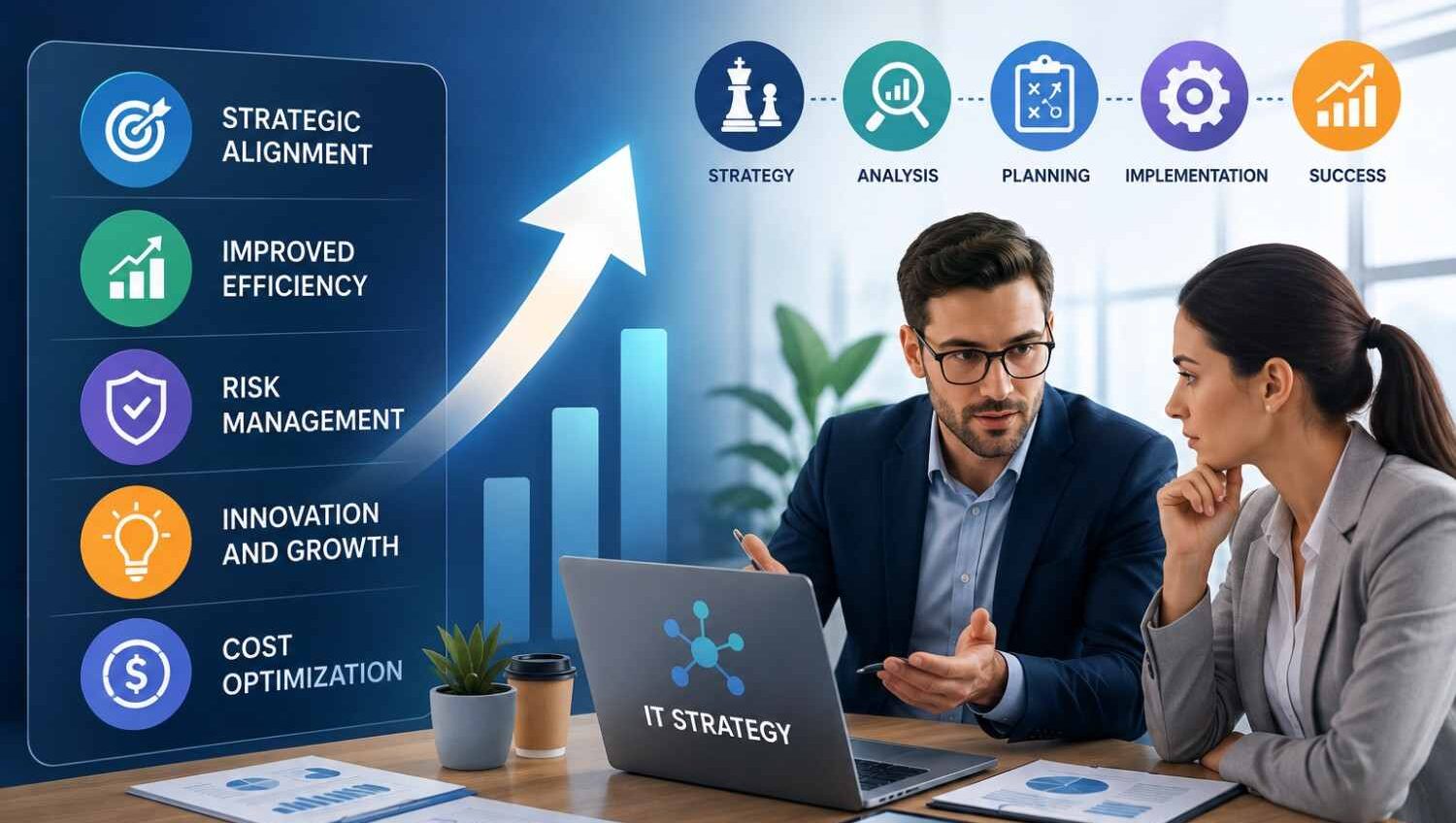
IT budgets keep climbing every year. That doesn’t mean the money is being spent well. Plenty of companies buy new software, move to the cloud, or roll out automation tools because a vendor pitched hard, not because it ties back to revenue or efficiency. That’s the gap IT strategy consulting is built to close. A consulting partner steps back from the day-to-day fire drills and maps technology spending to what the business actually needs, rather than whatever platform is getting attention this quarter. Do that well and a company wastes less money, moves faster on projects that matter, and has a real answer for where things stand in three years. Below, we’ll look at how IT strategy consulting shows up in ROI, what separates a good consulting provider from a mediocre one, and the details worth checking before signing anything.
How IT Strategy Consulting Improves Business ROI
Every tech purchase costs more than what’s on the invoice. Vendor evaluations eat weeks. Rollouts disrupt whatever team touches them first. And there’s always the risk the tool you picked can’t keep up as the business grows. IT strategy consulting reduces all three by putting a structured plan in place before money moves.
Alignment is where most of the savings come from. A consultant doesn’t start with what’s trending, they start by asking what the business is actually trying to achieve. Need faster order fulfillment? The answer might be process automation, not a full ERP overhaul. Money goes toward the bottleneck, not toward whatever the industry is buzzing about this year.
Skip the outside expertise and you tend to learn the same lessons the hard way, usually at full price. A platform that won’t talk to your existing systems. A security gap nobody notices until after the breach. A migration that doubles in length. IT strategy consulting exists partly to short-circuit that process, since the patterns behind those mistakes have already played out elsewhere.
There’s also the stuff nobody budgets for: redundant systems, the workaround someone built years ago that finance now depends on, the manual process eating four hours a week for no good reason. Cleaning that up frees up staff time, and it shows up directly in the bottom line.
Then there’s scale. What runs fine for fifty employees can fall over at five hundred. Good IT strategy consulting bakes that growth curve into the plan up front, so infrastructure doesn’t need a costly rebuild later. Factor in the risk side, cybersecurity gaps, compliance requirements, vendor lock-in, and it’s clear why businesses that invest in IT strategy consulting get more out of every technology dollar than the ones figuring it out as they go.
How to Choose the Right IT Strategy Consulting Provider
Consulting firms aren’t interchangeable, whatever their pitch decks want you to believe. The ones worth hiring know your industry already, or at least ask enough sharp questions before they open PowerPoint. Ask for specifics: past engagements with results you can actually measure, not a strategy document that looked good and sat in a drawer.
It also helps to look at how a provider approaches execution, not just planning. A strategy document only has value if it can actually be implemented. Some businesses pair their IT strategy consulting engagement with additional execution support, such as working with an IT staffing agency to bring in the right technical talent quickly. If you’re based in Texas, that often means teaming an IT staffing agency in Dallas with the consulting engagement itself, so the roadmap keeps moving instead of stalling out in a six-week internal hiring process.
Communication matters more than people expect going in. The good ones explain a recommendation in plain English and tie it back to something the business actually cares about, then stick around when priorities shift instead of disappearing after the handoff. If a provider leans on jargon or keeps steering every conversation toward the same technology stack, that’s worth noticing.
Key Factors to Consider Before Hiring an IT Strategy Consultant
A handful of checks before signing anything will save you from a mismatched engagement later.
Start with industry experience. A consultant who already knows your sector spots constraints and openings faster than someone starting from a blank slate, so you’re not funding their learning curve.
Push for a real scope. Vague advice sells easily and does little, so get specific outcomes, real timelines, and a way to measure whether any of it worked.
Ask about change management too. Plenty of strategies fail not because the technology was wrong, but because nobody trained the people who had to use it every day.
Watch for vendor ties. A consultant locked into one software ecosystem has a reason to recommend it that has nothing to do with your business.
Find out what happens after the report gets delivered. Some providers adjust the plan as things change, others consider the job done once the invoice clears.
And get the numbers up front, all of them, including whatever staffing or implementation costs tend to get mentioned later.
Skip these checks and you risk paying for a strategy that reads well but falls apart the moment someone tries to execute it.
Final Thoughts
IT strategy consulting exists to make sure each technology decision actually serves the business behind it. Companies that take this seriously tend to spend more efficiently, adapt faster when growth demands it, and sidestep the expensive missteps that come from planning technology reactively. Who you hire matters as much as the decision to hire at all. Look for real industry knowledge, results you can point to, and a willingness to stick around for execution, whether that’s implementation or talent through an IT staffing agency. Vofox works with businesses on exactly this kind of roadmap, turning strategy into systems that actually move the needle. If your technology decisions feel more reactive than planned, that’s usually the clearest sign it’s time to bring someone in from outside.
Frequently Asked Questions
Q1: What is IT strategy consulting?
A: It’s an advisory service that lines up a company’s technology investments, infrastructure, and digital initiatives with what the business is actually trying to accomplish. Rather than making tech decisions in isolation, IT strategy consulting gives a business a roadmap for how technology should support growth, efficiency, and staying competitive.
Q2: What are the main benefits of IT strategy consulting services?
A: Less wasted technology spend, faster movement on major initiatives, stronger risk management, and infrastructure that’s actually built to handle growth. It also cuts down on expensive trial and error, since a good IT strategy consulting partner has usually seen the mistake play out somewhere else already.
Q3: When should a business invest in IT strategy consulting?
A: A few common signs include: technology spending starts feeling reactive, growth is straining systems that used to be fine, a major digital transformation project is on the horizon, or past investments simply haven’t paid off the way they were supposed to.
Q4: How does IT strategy consulting help reduce technology costs?
A: Mostly by catching the waste before it happens, redundant tools, manual processes that should’ve been automated, software purchases that don’t fit the problem. IT strategy consulting keeps the budget pointed at systems that solve something real instead of adding another layer of complexity.
Q5: How do I choose the right IT strategy consulting company?
A: Look for industry experience, a clear and measurable scope of work, vendor neutrality, and support beyond the strategy document itself, including help with execution, whether that is implementation or staffing support through a partner like an IT staffing agency.