A customer enquiry arrives, a sales lead waits for qualification, or an employee needs information buried across five different systems. Your team handles each request manually, one task at a time. As these workflows multiply, valuable hours disappear into work that could be completed faster with the right technology.
An AI agent can manage multi-step tasks, retrieve information, interact with business software, and complete actions based on defined instructions. But building one that works reliably requires more than selecting an AI model. It takes the right use case, secure integrations, clear business rules, and careful testing.
Working with an experienced AI development company can help turn a business requirement into an AI agent that performs useful tasks within your existing operations.
Building an AI agent starts with a clear business use case and moves through model selection, system integration, testing, and deployment.
What Is an AI Agent and How Does It Work?
An AI agent is a software system that completes tasks on its own, without a human pushing every button along the way. Unlike a basic chatbot that answers one question at a time, an agent can plan a sequence of steps, pull data from multiple sources, and take action to reach a goal.
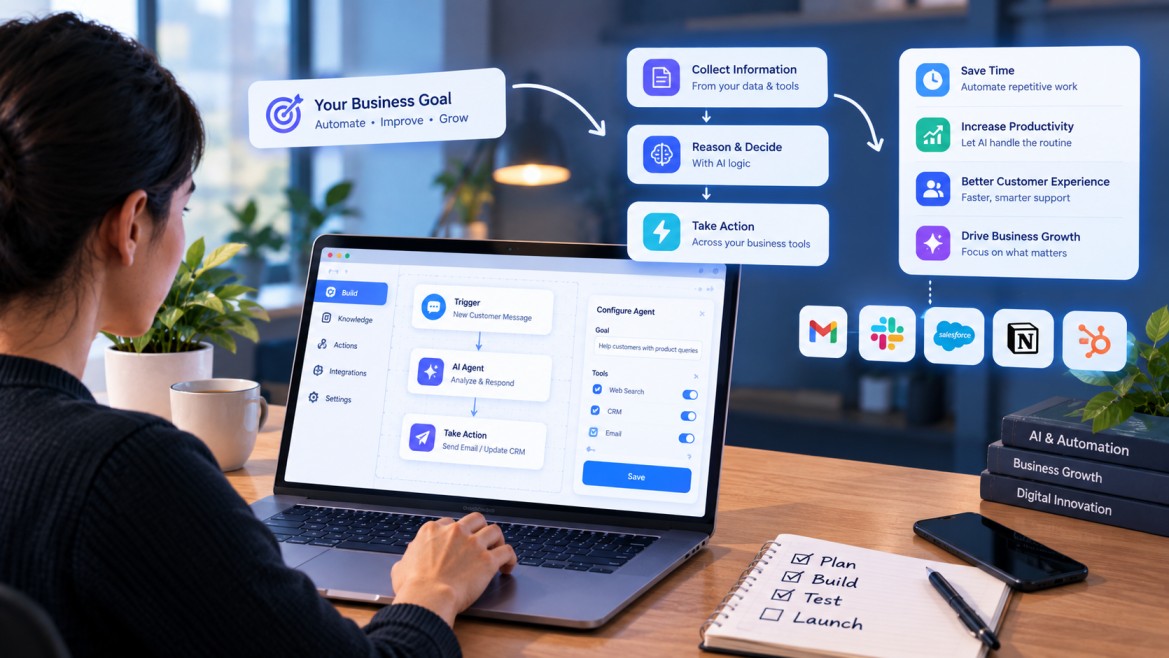
Most AI agents combine a reasoning model, context or memory, and tools that allow them to interact with external systems. A reasoning layer, usually a large language model, decides what needs to happen next. A memory or context layer keeps track of what has already happened in the task. A tool layer connects the agent to your actual business systems, such as your CRM, inventory database, or email platform, so it can act rather than just talk.
According to McKinsey’s 2025 State of AI survey of 1,993 participants, 88% of respondents said their organizations regularly use AI in at least one business function, up from 78% in 2024. The research also found that 62% were experimenting with or scaling agentic AI.
A well-built agent can respond to a trigger, reason through the required steps, execute actions across connected systems, and report the outcome. That loop is what separates a true AI agent from a scripted automation or a simple chatbot.
How to Build an AI Agent for Your Business
Building an AI agent involves defining the business problem, deciding what the agent should handle, selecting the right AI model, connecting business systems, setting boundaries, and testing the solution before deployment.
-
Define the Business Use Case
Start with a specific business workflow where an AI agent can handle multiple steps or decisions. Identify the problem, the people involved, the systems used, and the outcome you want the agent to achieve.
For example, a sales agent could qualify incoming leads, retrieve customer information from a CRM, update lead records, schedule follow-ups, and send complex cases to a sales representative.
-
Set the Agent’s Responsibilities
Define exactly what the AI agent can and cannot do. List the tasks it should perform, the information it can access, the decisions it can make, and the situations that require human approval.
Clear responsibilities help prevent the agent from taking actions outside its intended purpose and make testing easier before deployment.
-
Choose the AI Model
Select an AI model based on the agent’s tasks, reasoning requirements, response speed, data needs, and budget. Different models can vary in their capabilities, context limits, latency, and usage costs.
For simple classification or extraction tasks, a smaller model may be sufficient. More complex workflows may require a model with stronger reasoning and tool-use capabilities.
-
Connect Business Systems
An AI agent needs access to the systems required to complete its tasks. Connect relevant CRMs, ERPs, databases, help desks, communication platforms, or internal applications through APIs, connectors, or custom integrations.
Define permissions carefully so the agent can access only the information and functions required for its role.
-
Add Knowledge and Context
Give the agent access to the business information it needs to produce relevant responses and complete tasks. This can include internal documents, product information, policies, databases, customer records, or knowledge bases.
Retrieval systems can allow the agent to access relevant information when needed without requiring the underlying AI model to be trained on every piece of company data.
-
Set Guardrails and Human Oversight
Establish rules for what the agent can access, change, approve, or communicate. Sensitive actions such as financial transactions, account changes, or high-impact customer decisions may require human approval.
Add escalation rules so the agent can hand a task to an employee when it encounters uncertainty, missing information, or an exception.
-
Test, Deploy, and Monitor
Test the agent with real-world scenarios before making it available to users. Evaluate its responses, tool usage, system integrations, error handling, security controls, and escalation behaviour.
After deployment, monitor performance, failures, costs, response quality, and user feedback. Continue testing and updating the agent as your workflows, systems, and business requirements change.
Benefits of Building a Custom AI Agent
Building a custom AI agent can help businesses automate multi-step workflows, reduce manual work, improve access to business information, handle higher task volumes, and deliver more consistent customer and employee experiences.
Because the agent can be designed around your workflows, data, business rules, and existing software, it can address specific operational needs that general-purpose AI tools may not support.
- Save Time on Repetitive Work
An AI agent can handle tasks such as lead qualification, invoice processing, appointment scheduling, and support triage. It can collect information, check records, update systems, and route tasks, freeing employees for work that needs human judgment.
- Improve Accuracy and Consistency
A custom agent can follow approved business data, policies, and workflows to deliver consistent results. Data quality, testing, system design, and human oversight still determine its reliability.
- Handle Higher Task Volumes
AI agents can process multiple requests without requiring employees to manage every step manually. They can classify queries, retrieve information, and route complex cases, helping teams handle growing workloads more efficiently.
- Control Operational Costs
Automating suitable workflows can reduce staff time spent on repetitive tasks and help businesses handle higher volumes with existing resources. Costs still depend on development, integrations, AI usage, infrastructure, maintenance, and oversight.
Why Work With an AI Agent Development Company?
Building an AI agent in-house requires expertise across AI engineering, software development, data integration, security, deployment, and maintenance. Businesses without these capabilities may need to hire specialists, allocate internal resources, or manage multiple technical requirements before development begins.
An experienced AI development company can bring these skills together within one project. When evaluating AI development services, look for a partner that can support use-case discovery, AI architecture, system integration, testing, deployment, and ongoing maintenance. This gives businesses access to the required technical expertise without building the entire AI development team internally.
An AI development partner can assess your existing workflows and identify tasks that are suitable for automation while keeping human approval where it is needed. This is important when an agent works with customer, financial, operational, or other sensitive business information. Clear permissions, escalation rules, testing, and monitoring help keep the agent within defined boundaries.
As an AI software development company, Vofox combines AI, data analytics, and software consulting capabilities to help businesses identify suitable use cases, develop AI solutions, integrate them with existing software, and support them after deployment.
When evaluating the best AI development company for your project, consider its experience with your business workflows, technology environment, security requirements, integrations, and long-term support. Ask how the proposed agent will work with your existing systems and how the team will test, monitor, and maintain it after launch.
Have a business workflow that could benefit from an AI agent?
Get in touch with Vofox to discuss your use case, existing systems, and AI development requirements.
Frequently Asked Questions
1. How long does it take to build an AI agent for a business?
An AI agent can take a few weeks to several months to build. An AI development company will consider workflow complexity, integrations, data readiness, security, testing, and deployment requirements when estimating the timeline.
2. How much does it cost to build an AI agent?
AI agent development costs vary based on project complexity. The cost of AI development services depends on integrations, data requirements, AI model usage, security, custom development, infrastructure, and ongoing maintenance.
3. What technologies are used to build AI agents?
AI agents typically use large language models, APIs, databases, orchestration frameworks, and cloud infrastructure. An AI software development company may use OpenAI or open-source models, vector databases, Python, and cloud platforms such as AWS or Azure.
4. Can an AI agent integrate with our existing business software?
Yes, AI agents can integrate with existing business software through APIs, connectors, and custom integrations. An experienced AI development company can connect CRMs, ERPs, databases, help desks, and internal business applications.
5. Should I build an AI agent in-house or hire an AI development company?
Choose in-house development when you already have the required AI and engineering expertise. When evaluating the best AI development company, consider its technical expertise, integration experience, security practices, testing process, and ongoing support.