I asked an AI system last week about a regulation that changed in 2025. It gave me a confident, detailed answer citing the old rules. Completely wrong. Not because the AI was broken, but because it was trained on data from before the change and had no way to know things had updated.
Table of Contents
What RAG Actually Means
RAG in AI stands for Retrieval-Augmented Generation. That’s a mouthful, but the concept is straightforward. You’re taking a language model (the generation part) and connecting it to external information sources it can search through (the retrieval part) before generating responses.
Think of it this way. A regular AI language model is like someone who memorised a bunch of books years ago and now answers questions from memory. A RAG system is like someone who has access to a constantly updated library and actually looks things up before answering.
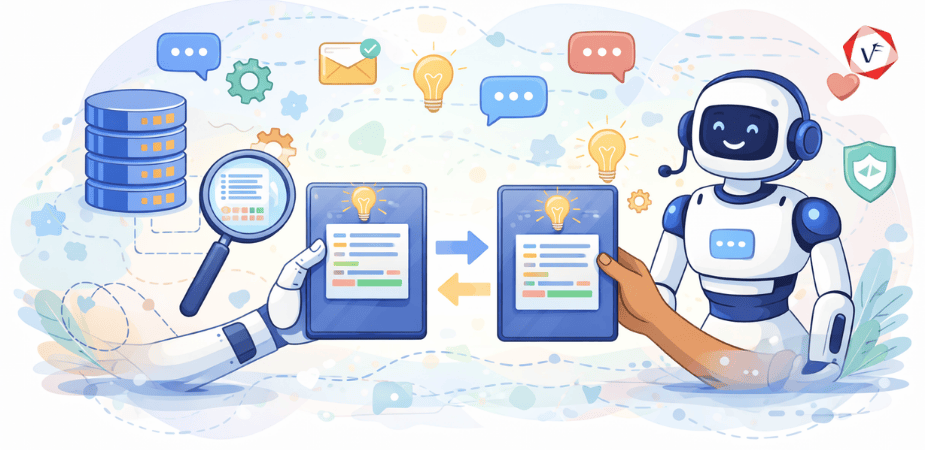
The architecture has two main pieces working together. The retrieval component searches through documents, databases, or knowledge bases to find relevant information. The generation component then takes that retrieved information and synthesizes it into a coherent answer.
Why This Matters
Traditional language models have a fundamental limitation. They only know what was in their training data, which means they have a knowledge cutoff date. Everything after that? They’re guessing based on patterns.
RAG systems sidestep this limitation entirely. The knowledge base can be updated continuously. New documents get added. Old information gets removed or corrected. The AI immediately has access to these changes without any retraining.
More importantly, RAG reduces what’s called hallucination. That’s when AI confidently states things that aren’t true. When responses are grounded in actual retrieved documents, the AI has less room to make stuff up. It’s working from source material, not just pattern matching.
How RAG Systems Actually Work
Understanding the workflow helps clarify why RAG performs differently than standard AI.
Step One: Query Analysis
When someone asks a question, the system first analyzes what’s being asked. Not just the literal words, but the intent behind them. What type of information would actually answer this question?
Step Two: Retrieval
The system converts the query into a format suitable for searching. This often involves creating vector embeddings, which are mathematical representations that capture semantic meaning. These embeddings let the system find relevant passages even when the exact wording doesn’t match.
Instead of just keyword matching (like old search engines), semantic search understands that “car accident” and “vehicle collision” mean similar things. That “financial loss” relates to “monetary damage.” This contextual understanding makes retrieval far more effective.
The system searches through its indexed knowledge base and ranks results by relevance. Maybe it finds ten passages that seem related to the query. Those get passed to the next step.
Step Three: Generation
The language model receives both the original question and the retrieved passages. This augmented input gives it specific, factual information to work with. The model synthesizes this information, combining multiple sources, drawing connections, and presenting everything in natural language.
What’s powerful about this approach is the flexibility. You can update the knowledge base without touching the language model. Add a hundred new policy documents? The system starts referencing them immediately. No retraining required.
Where RAG Gets Used in Practice
Retrieval-Augmented Generation applications span pretty much every industry that deals with complex information.
Customer Service
Chatbots using RAG can reference product manuals, policy documents, and troubleshooting guides while maintaining natural conversation. Instead of having to encode every possible answer into the bot’s training, companies just give it access to their documentation. The bot looks up the relevant section and explains it conversationally.
I’ve seen this work well when implemented properly. Customer asks about a return policy, the system pulls the actual policy text, and generates a human-readable explanation with the specific details that apply to their situation. No guessing. No outdated information.
Healthcare
Clinical decision support tools use RAG to reference medical literature, treatment protocols, and patient records. A doctor can ask about treatment options for a specific condition, and the system searches through current research and guidelines to provide relevant information.
The critical part here is source citation. Healthcare professionals need to verify information. RAG systems can point to specific studies or guidelines they referenced, which builds trust in a way pure language model outputs never could.
Legal Work
Legal professionals use RAG to analyze case law, contracts, and regulatory documents. The system can retrieve relevant precedents, identify applicable statutes, and help draft documents by pulling from extensive legal databases.
Law firms that have implemented these systems report significant time savings on research. Instead of junior associates spending hours searching case law, the RAG system does the initial pass and surfaces the most relevant cases. Humans still do the analysis, but they’re working from a much better starting point.
Financial Services
Banks and investment firms use RAG for compliance monitoring, risk assessment, and financial analysis. Systems scan through market reports, regulatory filings, and internal policies to provide insights that inform decision-making.
The compliance use case is particularly compelling. Regulations change constantly. A RAG system connected to updated regulatory databases can flag potential compliance issues in real-time, referencing the specific regulations that apply.
Education
Educational platforms use RAG to create intelligent tutoring systems that reference textbooks, academic papers, and course materials. Students get answers backed by authoritative sources instead of generic explanations.
This addresses a major concern with AI in education. Teachers want students learning from reliable information, not AI-generated approximations. RAG provides that reliability through source attribution.
The Technical Pieces That Make It Work
Implementing RAG requires several components working together smoothly.
The Knowledge Base
This is your source of truth. It could be product documentation, research papers, internal company documents, public databases, or any combination. The quality of your knowledge base fundamentally determines the quality of your system’s outputs.
Organizations have to decide what information to include. Too little and the system can’t answer many questions. Too much and retrieval becomes harder and slower. Finding the right scope takes thought.
Indexing and Vector Databases
Before the system can search efficiently, documents need to be processed and indexed. This typically involves:
- Breaking documents into manageable chunks (usually paragraphs or sections)
- Converting each chunk into vector embeddings using specialized models
- Storing these embeddings in databases optimized for similarity search
Vector databases like Pinecone, Weaviate, or Chroma have emerged specifically to handle these requirements. They’re designed for fast similarity searches across millions of embedding vectors, which is exactly what RAG systems need.
Retrieval Strategies
How the system searches matters enormously. Dense retrieval uses neural networks to create embeddings and find semantic matches. Sparse retrieval uses traditional keyword-based techniques. Hybrid approaches combine both, which often works best.
There’s no universal best approach. It depends on your data, your queries, and your performance requirements. Teams typically experiment with different strategies and measure what works for their specific use case.
Context Window Management
Language models have limits on how much text they can process at once. This creates a balancing act. You want to retrieve enough context to answer questions thoroughly, but you can’t exceed the model’s capacity.
Techniques like passage ranking (prioritizing the most relevant chunks), dynamic truncation (cutting less relevant parts), and intelligent chunking (breaking documents strategically) help optimize this balance.
Generation Parameters
How the language model generates responses requires tuning. Settings like temperature affect whether the model sticks closely to retrieved content or synthesizes more creatively. Lower temperatures generally produce more factual, conservative responses. Higher temperatures allow more creative interpretation.
For most RAG applications, you want relatively low temperatures. The goal is staying close to source material, not creative writing.
Why RAG Beats Traditional AI Approaches
The benefits of RAG over standalone language models are substantial and measurable.
Factual Accuracy
Grounding responses in retrieved documents dramatically reduces hallucination. The AI isn’t making things up from patterns. It’s working from actual text it just retrieved. That difference is enormous for professional applications where accuracy matters.
Source Attribution
RAG systems can cite specific documents or passages they referenced. This enables users to verify information and explore topics more deeply. In fields like healthcare, law, or journalism, this transparency isn’t just nice to have. It’s essential.
Currency Without Retraining
Traditional language models become outdated. Their knowledge cutoff is fixed at training time. RAG systems access current knowledge bases that can be refreshed continuously. Add yesterday’s policy update? The system uses it today.
The operational flexibility this provides can’t be overstated. Companies can maintain AI systems that stay current without the computational expense and complexity of constant retraining.
Domain Specialization
Organizations can create expert systems in narrow fields by curating specialized knowledge bases. You don’t need to train a model from scratch on legal documents or medical literature. You use a general-purpose language model and connect it to your specialized knowledge base.
This democratizes access to AI for specialized applications. Small companies can build sophisticated domain-specific systems without the resources to train custom models.
Cost Efficiency
Training large language models requires massive computational resources. RAG systems leverage pre-trained models while customizing knowledge through curated databases. The development and maintenance costs are substantially lower.
The Hard Parts of Implementing RAG
RAG isn’t a magic solution. Implementation comes with real challenges.
Retrieval Quality Is Critical
If your retrieval is bad, your answers will be bad. The system can’t generate good responses from irrelevant passages. Optimizing retrieval (choosing the right embedding model, tuning search parameters, handling edge cases) requires significant effort and expertise.
There’s also the question of what happens when relevant information doesn’t exist in the knowledge base. The system needs to recognize this and communicate it clearly rather than trying to answer anyway with tangentially related material.
Latency Concerns
Each query requires both retrieval and generation. This can increase response time compared to pure language model inference. For applications where speed matters, this requires optimization. Caching frequently accessed passages, implementing efficient indexing, and choosing fast vector databases all help.
But there’s a fundamental trade-off between thoroughness and speed. More comprehensive retrieval takes longer. Finding the right balance depends on your application’s requirements.
Knowledge Base Quality
Garbage in, garbage out. If your knowledge base contains outdated, biased, or incorrect information, your RAG system will propagate those problems. Maintaining document quality requires ongoing effort.
Organizations need processes for:
- Regular content audits to identify outdated information
- Version control to track changes and enable rollbacks
- Quality validation to catch errors before they reach production
- Deduplication to prevent the same information appearing multiple times
This operational overhead is real and shouldn’t be underestimated.
Handling Conflicting Information
What happens when retrieved passages contradict each other? The system needs logic to determine which information to prioritize or acknowledge the disagreement explicitly. This requires more sophisticated synthesis than simple concatenation.
Some RAG implementations handle this well, noting when sources disagree and presenting multiple perspectives. Others struggle with it, sometimes picking one source arbitrarily or generating confused responses that try to reconcile incompatible information.
Where RAG Technology Is Heading
Several developments are expanding what RAG systems can do.
Multimodal RAG
Current RAG systems mostly work with text. Emerging systems can retrieve and incorporate images, videos, and structured data. This enables richer responses that better match how humans actually process information.
Imagine asking about a complex process and getting back not just text explanation but relevant diagrams, video clips, and data visualizations. That’s where multimodal RAG is heading.
Active Learning Integration
RAG systems are starting to identify gaps in their knowledge bases and request new information when needed. This creates a feedback loop where the system continuously improves based on actual usage patterns.
If the system frequently can’t find good answers for certain types of questions, it can flag this for human review and suggest what additional documentation would help.
Personalization
RAG systems are beginning to adapt to individual users or organizational contexts. By maintaining user-specific context or prioritizing certain types of sources, these systems provide more relevant responses tailored to specific needs.
This could mean a customer service RAG system that knows your account history and preferences, or an enterprise system that understands which departments need which types of information.
Common Questions About RAG
What is RAG in AI in simple terms?
RAG (Retrieval-Augmented Generation) is a technique that connects AI language models to external information sources. Instead of relying only on what it learned during training, the AI searches through documents or databases to find relevant information before answering. It’s like giving the AI a library it can reference in real-time.
How does RAG work in practice?
When you ask a question, the RAG system first searches through its knowledge base to find relevant passages. Then it feeds both your question and the retrieved information to the language model, which generates an answer based on that specific context. This grounds the response in actual documents rather than just pattern matching from training data.
Why is RAG better than regular AI language models?
RAG reduces hallucination by grounding responses in real documents. It can cite specific sources, stays current without retraining, and works with specialized knowledge bases. Traditional language models get outdated and can confidently state incorrect information. RAG systems reference verifiable sources, which makes them more reliable for professional applications.
What industries use RAG technology?
Customer service uses RAG for chatbots that reference product manuals and policies. Healthcare uses it for clinical decision support. Legal professionals use it to analyze case law and contracts. Financial institutions use it for compliance monitoring and analysis. Education platforms use it for intelligent tutoring systems that cite textbooks and academic papers.
What are the challenges with implementing RAG?
Retrieval quality directly affects answer quality. Poor search results lead to poor responses. Latency can be higher than pure language models since you’re doing both retrieval and generation. Knowledge base quality matters enormously. If your documents are outdated or wrong, the system propagates those errors. Handling conflicting information from different sources requires sophisticated logic.
Can you update a RAG system without retraining?
Yes. That’s one of RAG’s biggest advantages. You can add new documents, update existing ones, or remove outdated content, and the system immediately uses the new information. Traditional language models require expensive retraining to update their knowledge. RAG separates the knowledge base from the model itself.
What’s the difference between RAG and fine-tuning?
Fine-tuning adjusts a language model’s parameters through additional training on specific data. RAG doesn’t modify the model at all. It just gives the model access to external information sources. Fine-tuning requires technical expertise and computational resources. RAG requires curating a good knowledge base. For most applications, RAG is simpler and more flexible.
How much does it cost to implement RAG?
Costs vary widely based on knowledge base size, query volume, and infrastructure choices. You need vector database hosting, embedding model usage, and language model API calls. For small deployments, this might be hundreds per month. For enterprise scale, it can reach thousands. But it’s typically much cheaper than training custom models.
The Bottom Line on RAG
Retrieval-Augmented Generation represents a practical solution to real limitations in AI systems. By connecting language models to external knowledge sources, RAG delivers accurate, verifiable, and current responses across applications from customer support to specialized professional tools.
It’s not perfect. Retrieval quality matters. Knowledge base maintenance takes effort. Latency can be a concern. But for organizations that need AI systems capable of referencing authoritative sources while maintaining conversational interfaces, RAG provides capabilities that standalone language models simply can’t match.
The technology continues maturing. Multimodal capabilities are expanding. Active learning is improving knowledge base management. Personalization is making systems more contextually aware. These developments are making RAG more powerful and easier to implement.
If your organization is looking to implement AI solutions that combine natural language capabilities with reliable, current information access, Vofox’s AI development services offer expertise in designing and deploying RAG systems tailored to your specific needs and industry requirements. Contact us today and see how our AI experts can help you build systems that actually work for your business.